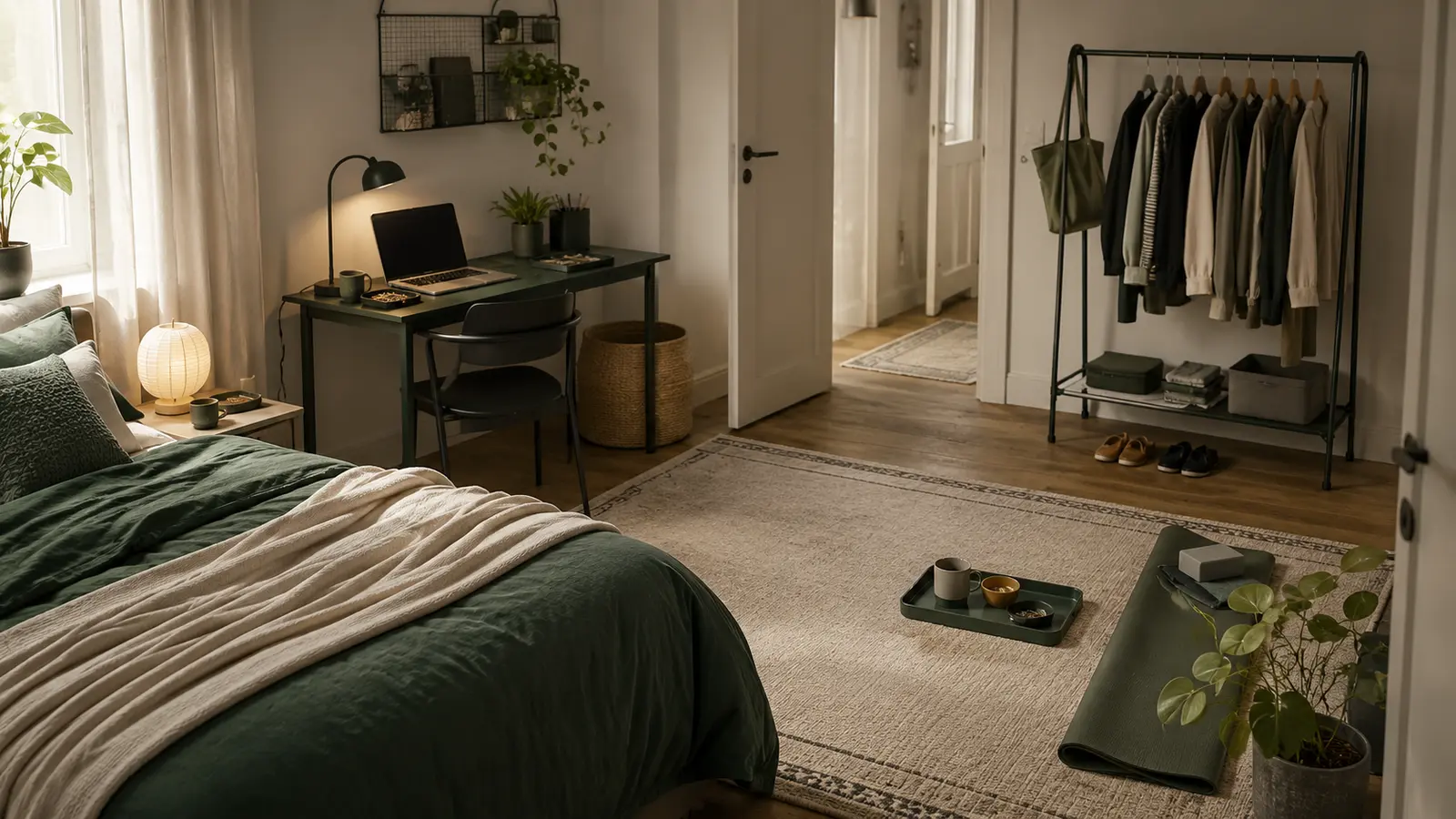
The Small-Room Zone Map: Create Separate Functions Without Adding Furniture
Last updated:
A small room can support several parts of daily life without treating every corner as permanent storage. This guide helps you map the room by function, protect safe movement, and define clear zones using the space and belongings already available before considering additional furniture.
Start With Functions, Not Furniture
First identify what must happen in the room. Possible functions include sleeping, dressing, working or studying, eating, relaxing, personal care, household storage, hobbies, and preparing to leave home. Not every room needs every function.
Furniture should support the selected activities rather than decide them automatically. A desk that is rarely used may not deserve the same space as safe sleep, necessary clothing access, or a daily work surface.
List the Room’s Required Activities
Complete a short activity audit:
- What must happen in this room?
- What happens daily?
- What happens only occasionally?
- Which activities require privacy, light, power, a surface, seating, or open floor space?
- Which activities could happen elsewhere?
- Which belongings support each activity?
Select a few priority functions instead of expecting one small room to support everything equally. Daily and necessary activities should receive the clearest space. Occasional activities can use movable kits or temporary surfaces.
Protect Non-Negotiable Clearances
Before placing zones, identify doors and exits, walking routes, windows that must open, ventilation points, heaters and radiators, electrical panels and outlets, appliance clearances, wardrobe and drawer openings, and accessible routes needed by household members.
Do not rely on an invented universal measurement. Follow applicable manufacturer instructions, building rules, rental requirements, and safety guidance. A zone is not workable if it prevents a door, drawer, window, or mobility aid from operating safely.
Choose an Anchor for Each Priority Zone
Each main function needs one physical anchor:
- A bed anchors sleeping.
- A desk or defined work surface anchors working or studying.
- One drawer or clothing rail anchors dressing.
- A chair and suitable lamp anchor reading.
- A tray or container anchors personal-care items.
- A clear section of floor anchors a temporary activity.
The anchor defines where the activity begins. It does not give the activity permission to spread across the entire room. Work papers belong at the work anchor, not automatically on the bed, chair, and floor.
Create Boundaries Without Building Walls
Use simple visual and behavioural boundaries already safely available: furniture position, a rug already owned, one tray or container, a section of a shelf, a lighting change, a clear edge on a shared surface, a storage destination, or a rule about where an activity starts and ends.
A work zone might be one half of a table and one drawer. A dressing zone might end at the wardrobe door. A reading zone might exist only when a lamp is on and a book kit is beside the chair. Boundaries should be easy to restore after use.
Use Movable Activity Kits
Group supplies for occasional activities into portable kits: a work kit, study kit, craft kit, personal-care kit, charging kit, or exercise kit. Each kit should contain only necessary items, have one storage destination, be easy to retrieve and return, and fit within a defined capacity.
A kit allows a shared surface or floor area to change roles without leaving every activity visible. Store it where it never obstructs an exit or walkway.
Make Shared Surfaces Change Roles Safely
- Finish the current activity.
- Remove rubbish or unsafe materials.
- Return the activity kit.
- Wipe the surface appropriately if needed.
- Bring out the next activity’s items.
- Restore the surface after use.
Incompatible activities may need separate surfaces or appropriate cleaning and safety controls. Food preparation should not share an inadequately cleaned surface with chemicals, repair work, or craft materials.
Store by Frequency and Point of Use
- Keep daily items easiest to reach.
- Place occasional items in less accessible suitable storage.
- Keep heavy items on stable, suitable lower storage.
- Store frequently used belongings near the activity they support.
- Move items used in another room to that room when a suitable destination exists.
Do not create unsafe overhead storage or stand on unsuitable furniture. Easy access matters more than using every vertical gap.
Measure Before Adding Anything
Measure available width, depth, and height; door and drawer movement; walking routes; existing furniture; belongings intended for storage; and safe access requirements. Record the narrowest usable dimensions, not just the empty wall length.
Buying storage before identifying the exact problem can reduce usable space. First decide which function lacks an anchor, boundary, or destination. Then determine whether anything additional is actually needed.
An Adaptable Zone-Planning Example
This table is an example to customise, not a required room arrangement.
| Function | Anchor | Items required | Boundary | Reset action |
|---|---|---|---|---|
| Sleeping | Bed | Bedding and night essentials | Bed surface and bedside section | Remove unrelated items |
| Working | Defined table area | Current device and work kit | One edge or tray | Return work kit |
| Dressing | Wardrobe or drawer | Current clothing | Storage opening and nearby standing space | Return clothing |
| Relaxing | Chair and lamp | One book or activity kit | Chair footprint | Return kit and clear seat |
| Occasional hobby | Clear floor or shared surface | Portable hobby kit | Temporary marked area | Pack kit completely |
A 30-Minute Room-Mapping Session
Thirty minutes is a planning boundary, not a promise that the room will be fully reorganised. Do not move heavy furniture alone.
- Minutes 0–5: list required room functions.
- Minutes 5–10: mark doors, routes, ventilation, and fixed features.
- Minutes 10–15: choose priority functions.
- Minutes 15–20: assign one anchor to each priority function.
- Minutes 20–25: identify items that support each zone.
- Minutes 25–28: define boundaries and reset actions.
- Minutes 28–30: test movement through the room.
When the Room Contains Too Much
- Remove items that clearly belong elsewhere.
- Consolidate duplicates only when ownership and use are understood.
- Relocate seasonal or occasional items where suitable storage exists.
- Repair, donate, recycle, or discard only items you own or have permission to handle.
- Keep undecided items in a small, dated review container rather than an unlimited hidden pile.
The purpose is to support required functions, not pressure anyone to discard possessions. If an item must stay, decide which function it supports and where its boundary is.
Shared and Rented Rooms
Assign clear personal zones and agree on reset expectations for shared surfaces. Ask permission before moving another person’s belongings. Prefer temporary and removable solutions, and obtain landlord or property-manager permission where required.
Discuss quiet, privacy, accessibility, and schedule needs. A visible agreement about shared storage capacity can prevent one person’s supplies from displacing another’s necessary zone.
The Seven-Day Zone Test
For seven days, observe which activity spreads beyond its boundary, which item has no destination, which zone blocks movement, which activity needs more setup than expected, which storage point is difficult to reach, which surface is asked to do too many things, which zone is rarely used, and which shared expectation is unclear.
Adjust one zone or boundary at a time. Move a kit, reduce one zone’s capacity, clarify a reset action, or allow an activity to happen elsewhere, then test again.
Troubleshooting the Zone Map
| Problem | Likely cause | Small adjustment |
|---|---|---|
| Work items spread onto the bed | The work boundary is unclear | Use one defined surface and return kit |
| Clothing gathers on a chair | Worn clothing has no destination | Assign an appropriate temporary clothing spot |
| A shared surface never becomes available | No reset expectation exists | Agree when each activity must clear |
| Activity kits are not returned | Storage is difficult or too small | Move or simplify the kit destination |
| The walking route becomes blocked | A zone expanded onto the floor | Restore the route and reduce capacity |
| Storage is difficult to reach | Frequency and location do not match | Swap daily and occasional items |
| One zone takes over the room | Its boundary is undefined | Set a physical edge and finish line |
| The room still feels crowded | Too many functions remain active | Move one occasional function into a kit |
A Five-Minute Zone Reset
Five minutes is a time boundary, not a guaranteed completion time.
- Return each activity kit.
- Clear the main shared surface.
- Move clothing to its proper destination.
- Remove rubbish.
- Restore the walking route.
- Prepare the next required activity.
Saveable Small-Room Zone Checklist
- List required room functions.
- Choose a few priority functions.
- Protect all safety clearances and access routes.
- Give each priority zone one anchor.
- Define a visible or behavioural boundary.
- Group occasional activities into portable kits.
- Store by frequency and point of use.
- Measure before adding anything.
- Respect shared-space ownership and permissions.
- Test the zone map for seven days.
- Change one zone or boundary at a time.
Safety Note
Keep doors, exits, stairs, windows, ventilation, heaters, electrical equipment, and required access routes unobstructed. Follow furniture, shelf, adhesive, fastener, appliance, and product instructions and weight limits. Do not move heavy or unstable furniture without appropriate help or stand on unsuitable furniture. Secure tall or unstable furniture where appropriate and permitted, following manufacturer and property requirements. Consider children, pets, mobility needs, trip hazards, and emergency access. Obtain permission before drilling or altering rented or shared property. Seek qualified help for electrical, structural, ventilation, mounting, moisture, mould, pest, or unknown-material concerns.
Related guidance is available in Small-Space Living, the Entryway Landing Zone, and About Baaydo.

