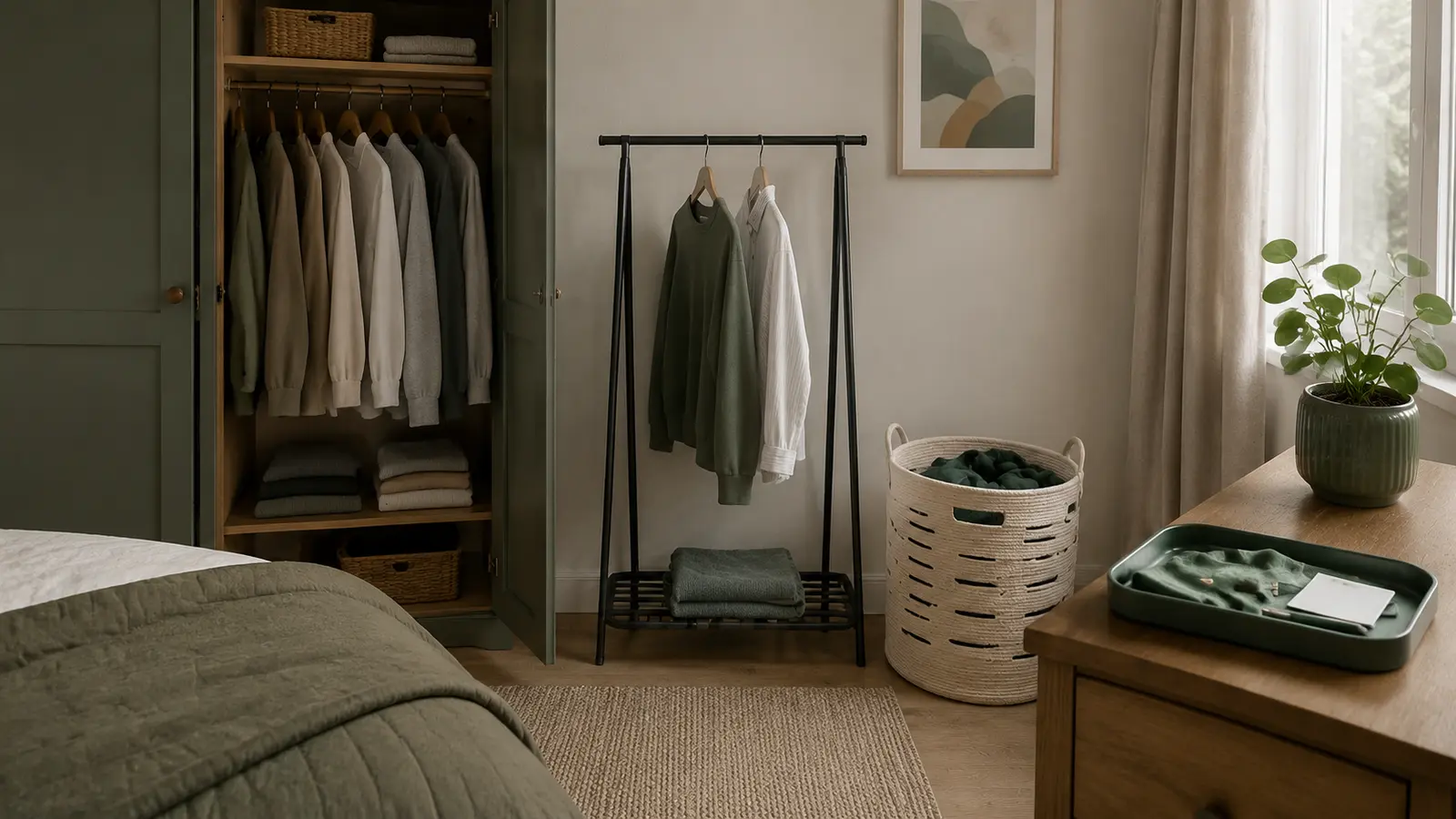
The Clothing Transition Station: Decide What Returns, Rewears, Washes, or Needs Action
Last updated:
Clothing left on a chair, bed, or floor often represents several unfinished decisions rather than one kind of mess. A clothing transition station gives removed garments clear next destinations so clean storage, possible rewear, laundry, and action items do not merge into one pile.
Understand the Transition Problem
A clothing pile may include clean garments ready to return, items the owner may consider wearing again, laundry, damaged pieces, borrowed clothing, or items affected by an unknown condition. When every state shares one surface, it becomes difficult to know what can move and where.
The station does not decide whether a garment is suitable to wear again. That depends on its condition, use, care instructions, and individual circumstances. The method simply makes the next decision and destination visible.
Define the Possible Destinations
- Return to clean storage.
- Temporarily designate for possible rewear.
- Move to the appropriate laundry collection.
- Place in a small repair or action area.
- Return to another room or owner.
- Use separate appropriate handling for an unsuitable or uncertain condition.
Not every household needs every destination. Use only the states that match actual routines, ownership, space, labels, and safe handling requirements.
Make the Decision When Changing Clothes
Where practical, pause at the point of changing clothes and choose the next route before the garment reaches a chair or floor.
- Is the item clean and ready for normal storage?
- Does the owner consider it suitable for possible rewear?
- Does it belong in the laundry process?
- Is it damp, visibly soiled, contaminated, damaged, or affected by an unknown substance?
- Does it require repair or another person’s decision?
- Are pockets empty and personal items removed?
These questions organise the route; they do not make hygiene or medical decisions. When the condition is uncertain, keep the item separate and follow suitable instructions or seek appropriate help.
Choose a Small Fixed Boundary
Use an existing hook area, shelf section, drawer, basket, or wardrobe section only when it is safe and suitable. A new product is not required. Define exactly where the station begins and ends.
Keep it stable, accessible, and away from exits, walking routes, ventilation, heaters, utilities, and electrical equipment. The station should intercept clothing without becoming new furniture spread across the room.
Separate Clean-Ready Clothing
Clean-ready clothing should return to its normal suitable storage rather than remain in the station. Keeping it separate protects the meaning of clean storage and makes the transition area easier to review.
Do not return damp, visibly soiled, contaminated, or uncertain items to clean storage. Follow garment labels and appropriate handling guidance before deciding their route.
Define the Possible-Rewear Location
A possible-rewear area is a temporary location for garments the owner may consider using again. It must have fixed capacity, remain distinct from clean storage and laundry, and allow handling appropriate to the garment and its instructions.
Do not seal damp items in unventilated storage. When the area reaches capacity, review existing garments before adding more. The location is a decision stage, not permanent wardrobe overflow.
Define the Laundry Destination
Move laundry into the collection arrangement appropriate to the garment and household. Read care labels and follow household sorting, laundry-product, appliance, and laundromat requirements.
Do not assume every item can share one hamper or wash cycle. Items requiring separation, prompt handling, specialist care, or another instruction should remain clearly apart until their correct route is known.
Create a Small Repair or Action Area
Use a small fixed space for garments needing a repair assessment, button or fastener attention, owner permission, return to another room, professional care based on the label, or another specific decision.
Give each item an exact action, responsible person, and review point. “Deal with later” is too vague. Repair only within the responsible person’s ability and do not allow the area to become permanent storage.
Check Pockets and Accessories
Before clothing enters storage or laundry, check pockets and attached or removable accessories as appropriate. Protect keys, identification, money, electronics, tissues, detachable parts, and borrowed items.
Return personal belongings to their safe destinations and follow garment or appliance instructions for detachable parts. Ask permission before handling another person’s pockets or possessions.
Set Capacity Limits
Assign a clear maximum to the possible-rewear and action areas based on safe usable space. When either is full, process existing items before adding more.
Do not expand the station across chairs, beds, floors, doors, or walking routes. A fixed boundary reveals which decision is delayed and keeps normal living surfaces available.
Adaptable Clothing-State Table
| Clothing state | Next destination | Decision question | Finish line | Review trigger |
|---|---|---|---|---|
| Clean-ready | Normal clean storage | Is it ready for its usual storage? | Garment returned to its assigned place | Clean items remain in the station |
| Possible rewear | Fixed separate rewear area | Does the owner consider it suitable for possible rewear? | Item stored distinctly within capacity | Capacity is reached |
| Laundry | Appropriate collection route | What do its label and sorting requirements indicate? | Item enters the correct laundry stage | Collection is missed |
| Repair or action | Small dated action area | What exact action and permission are needed? | Action and review point recorded | The review date arrives |
| Belongs elsewhere | Proper room, storage, or owner | Who owns it and where does it belong? | Returned with permission | It repeatedly returns to the station |
| Separate handling | Suitable isolated process | Is it damp, contaminated, damaged, or uncertain? | Kept separate pending appropriate guidance | Safe handling is unclear |
A 20-Minute Setup Session
Twenty minutes is a boundary, not a completion guarantee. Stop safely when time ends and record unresolved actions.
- Minutes 0–3: choose the location.
- Minutes 3–6: define destinations.
- Minutes 6–10: process current low-risk items.
- Minutes 10–13: check pockets and ownership.
- Minutes 13–16: assign capacity limits.
- Minutes 16–18: define action review points.
- Minutes 18–20: test the route and clear the walking area.
Adapt the Station for a Very Small Home
Use fewer clearly separated destinations and keep the physical boundary small. A hook section and one small action area may be enough when clean-ready items return immediately and laundry has its own route.
Avoid floor storage. Prioritise ventilation, safe access, existing storage, and an unobstructed route. If two states cannot remain distinct in the available space, process one rather than adding another container.
Use the Station Respectfully in a Shared Home
Separate ownership and obtain permission before moving another person’s clothing. Agree on shared laundry collection while respecting personal storage, privacy, accessibility, schedules, and ability.
Make no assumptions based on gender or household role. Each person may use a different safe route when destinations remain clear and shared areas stay within capacity.
Complete Every Route
- Clean-ready items return to suitable storage.
- Possible-rewear items receive a fresh decision before capacity is exceeded.
- Laundry enters the complete laundry flow.
- Action items receive their named next step.
- Misplaced items return to the proper destination with permission.
- Empty containers or hangers reset appropriately.
The transition station succeeds when items leave it through defined routes. It is not intended to hold every garment between uses indefinitely.
Run a Seven-Day Test
Observe what still lands on a chair or floor, which destination fills first, which decisions remain unclear, whether clean and used states mix, whether damp items receive appropriate handling, whether action items progress, and whether the location blocks movement.
Change one part at a time: a location, capacity, decision question, or review trigger. Continue until the route is understandable without spreading the station.
Troubleshoot the Transition Station
| Problem | Likely cause | Small adjustment |
|---|---|---|
| Clothing still collects on a chair | The decision point is inconvenient | Move the safe boundary closer to changing |
| Clean and possible-rewear items mix | The destinations are not distinct | Return clean items and mark the rewear boundary |
| Possible-rewear area overfills | No capacity review occurs | Review existing items before adding more |
| Laundry misses its collection point | The route or sorting need is unclear | Clarify the appropriate laundry destination |
| Damp clothing remains in a pile | Suitable handling was not defined | Keep it separate and follow instructions |
| Repair items never receive action | No named step or review point exists | Write one action, person, and date |
| Shared clothing becomes confused | Ownership is not identified | Separate items and ask before moving |
| The station spreads across the room | The boundary is treated as expandable | Restore fixed capacity and clear routes |
A Five-Minute Clothing Reset
Five minutes is a boundary. Identify each low-risk item’s state, empty pockets appropriately, return clean-ready clothing, move laundry to its suitable collection point, review the oldest action item, restore fixed capacities, and clear the walking route. Stop for any unsafe or uncertain condition.
Saveable Transition-Station Checklist
- Identify the clothing state.
- Choose the next suitable destination.
- Check pockets and detachable parts.
- Confirm ownership and permission.
- Keep clean, rewear, laundry, and action states separate.
- Respect fixed capacity.
- Give action items a specific step and review date.
- Complete each route.
- Keep floors and routes clear.
- Run the seven-day review.
- Change one part at a time.
Safety Note
Follow garment labels, laundry-product labels, and appliance instructions. Never mix products unless manufacturers explicitly direct it. Do not seal damp or contaminated items into ordinary storage. Secure products from children and pets as directed.
Keep exits, ventilation, heaters, utilities, electrical equipment, appliance clearances, and routes unobstructed. Seek appropriate help for contamination, mould, pests, chemicals, appliance faults, or unknown substances.
Continue with Laundry & Fabric Care, follow the wider route in the Laundry Flow System, or learn more About Baaydo.

