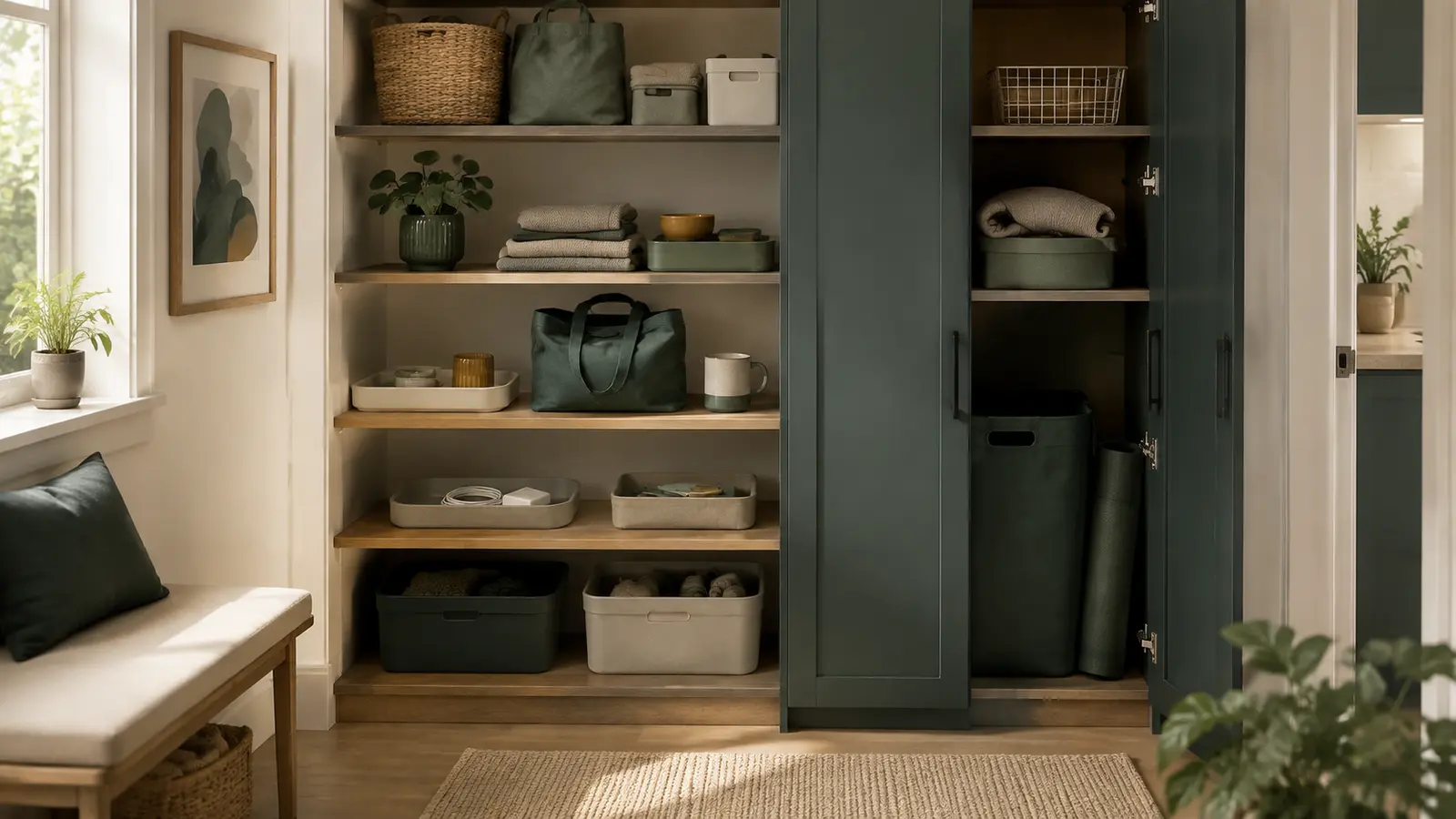
The Small-Space Storage Priority Ladder: Put Daily Items Within Easy Reach
Last updated:
Limited storage works better when its easiest positions are assigned deliberately. A storage priority ladder helps you decide which belongings deserve prime access, which can sit farther away, and which need a review before you buy furniture or organisers. It can adapt to apartments, studios, rented rooms, shared homes, limited cupboards, and different mobility or accessibility needs.
Understand the Storage Priority Ladder
The ladder has four adjustable levels. Prime access is for frequently used essentials. Standard access supports regularly used items that do not need the easiest position. Occasional access holds infrequently used belongings that remain safe and retrievable. Review or exit is for items that do not currently justify scarce storage.
These levels are prompts, not strict rules. An item can move when routines, seasons, work, household members, or accessibility needs change. The purpose is to match access to actual use and consequence, not to rank possessions by personal value.
Begin With One Storage Area
Choose one shelf, cupboard, wardrobe section, drawer unit, or safe under-bed area. Avoid emptying the entire room. A contained area lets you finish a useful decision, test retrieval, and return displaced items before expanding the project.
First describe the physical boundary: which shelf, drawer, rail, or section is included? Note anything that must remain in place. If the area contains another person’s belongings, ask permission before moving them.
Identify the Activities the Storage Supports
Storage is useful when it supports an activity. A wardrobe section may support getting dressed; a desk drawer may support current work; a cupboard may support meal preparation or household maintenance. Name the activity before deciding where each item belongs.
- What is used daily, regularly, or only occasionally?
- What must remain near its point of use?
- What belongs in another activity area?
- Who owns each item?
- Who needs access, and under what conditions?
A belonging used elsewhere may be occupying good storage simply because it was placed there temporarily. Return it only when its destination is known, safe, permitted, and ready to receive it.
Protect Safe Access First
Storage must not obstruct exits, walking routes, ventilation, heaters, electrical panels, utilities, doors, windows, or required appliance clearances. Follow manufacturer, building, fire-safety, and rental guidance that applies to the property and items.
Do not accept an unsafe position merely because space is scarce. If a location interferes with access or equipment, reduce what it holds, choose another permitted area, or seek appropriate advice. Safety comes before convenience or appearance.
Define Prime-Access Storage
Prime access is safely reachable, easy to see, and close to the activity it supports. It should allow the intended person to retrieve and return an item without unstable stacks, unnecessary lifting, or moving unrelated belongings.
Adjustable examples include everyday clothing, current work tools, daily personal items, or frequently used household supplies. There is no universal prime-access height. Suitable reach depends on the person, the item, the storage, and the environment.
Define Standard and Occasional Access
Standard access suits belongings used regularly but not required at the easiest point. They should remain visible or clearly identified and should not block prime items. Occasional access is for infrequent belongings that still justify their space.
Occasional storage must remain safe and retrievable. Never place heavy objects high, use unsafe overhead positions, overreach, or climb on furniture. If retrieval requires unsuitable effort or risk, the location is not appropriate even when the item is rarely used.
Sort by Frequency and Consequence
Frequency is only the first question. An item used less often may still need accessible storage because delay would disrupt an essential activity. Review each belonging with the following prompts:
- How often is it used?
- What happens if it is difficult to reach?
- Is it needed urgently?
- Is this its actual point of use?
- Is it heavy, fragile, or hazardous?
- Does another person need access?
- Does it fit safely without obstructing the area?
Use the answers together. A light occasional item may suit a secondary position, while a heavy regular item may need a lower stable location rather than a visually convenient shelf.
Place Heavy, Fragile, and Hazardous Items Appropriately
Follow labels, manufacturer instructions, weight limits, and storage guidance. Heavy items need stable support and a position that avoids unsafe lifting or falling risk. Fragile items need protection from impact and unstable stacking.
Secure hazardous products as directed, considering children, pets, access, ventilation, and incompatible materials. Do not apply universal chemical-storage rules. Product instructions and qualified guidance take priority.
Use Point-of-Use Storage Carefully
Frequently used items often work well near the activity: current work materials near the desk, everyday clothing near dressing space, or suitable supplies near where they are used. A short return path can help the area reset.
Point of use does not override safety, ownership, appliance clearance, building rules, or rental restrictions. If the nearest location is unsuitable, choose the closest safe and permitted alternative and make its purpose clear.
Set Capacity Before Adding Organisers
Drawers and doors must operate normally, shelves must remain within rated capacity, and items must not collapse or fall when retrieved. Leave enough working space to remove and return belongings. Empty space can make storage more usable.
Do not buy organisers before measuring the area and identifying the specific problem. A divider cannot solve excessive volume, an unsafe shelf, the wrong point of use, or unclear ownership. First decide what the storage must hold and how it needs to function.
Adaptable Storage-Priority Table
The examples below are adjustable. Assign levels according to the people, activities, property, and safety requirements in your home.
| Priority level | Typical use | Suitable access | Example item | Review question |
|---|---|---|---|---|
| Prime | Frequent or important to daily function | Safely reachable, visible, near activity | Adjustable: everyday clothing | Can the intended person retrieve and return it easily? |
| Standard | Regular but not needed at the easiest point | Clear, stable, and available without blocking prime items | Adjustable: regularly used work materials | Does this position match actual use? |
| Occasional | Infrequent but still needed | Safe, identifiable, and retrievable without risky reaching | Adjustable: an occasional activity item | Can it be retrieved safely when needed? |
| Review or exit | No current use or uncertain claim on space | Small separate decision area | Adjustable: an item awaiting ownership or use decision | What decision and review date are needed? |
A 30-Minute Storage-Priority Session
Thirty minutes is a boundary, not a completion guarantee. Stop safely when time ends, return anything that should not remain displaced, and record the next action.
- Minutes 0–4: choose one area.
- Minutes 4–8: define its purpose.
- Minutes 8–13: identify ownership and frequency.
- Minutes 13–18: identify prime-access items.
- Minutes 18–22: assign standard and occasional items.
- Minutes 22–26: check weight, safety, and access.
- Minutes 26–30: test retrieval and record one adjustment.
Use Multiple Locations Only for a Real Need
Keeping the same type of item in more than one location can make sense when separate activities genuinely require it, each location is safe, and capacity is sufficient. An accessible personal item may also need a defined position that differs from shared storage.
Avoid duplicates created only because the existing supply is hidden or difficult to return. Before adding another, check the current locations, ownership, point of use, and whether one visible address would work better.
Plan Shared and Rented Storage
Define personal and shared areas, ask permission before moving belongings, and agree how shared capacity is divided. Account for accessibility, schedules, privacy, and who needs to use the space. Make no assumptions about household roles or gender.
In a rented home, favour arrangements that respect the tenancy and property. Removable solutions may be appropriate when their instructions and property rules allow them. Obtain landlord permission before drilling, mounting, attaching, or making other alterations where required.
Measure Before Adding Storage
Measure the available width, depth, and height; door and drawer movement; walking routes; relevant furniture dimensions; item size; and safe reach. Check clearances, load ratings, access to services, and property restrictions.
Write down the problem the proposed storage must solve. If the difficulty is misplaced belongings, excessive volume, or unsafe access, adding a container or furniture may reduce usable space without fixing the cause.
Run a Seven-Day Retrieval Test
Use the area normally for seven days. Observe what is used, difficult to reach, returned incorrectly, duplicated, blocking another item, exceeding capacity, or stored far from its activity. Notice whose access works and whose does not.
Change one level or location at a time. Move a daily item into prime access, relocate one occasional item, or clarify one shared boundary, then observe the result. A single adjustment makes the next decision easier to evaluate.
Troubleshooting the Priority Ladder
| Problem | Likely cause | Small adjustment |
|---|---|---|
| Daily items are difficult to reach | Prime access is assigned by appearance, not use | Move one daily item to suitable easy access |
| Occasional items occupy prime space | Frequency was not reviewed | Assign a safe occasional location |
| Heavy objects are stored too high | Weight was considered after placement | Move them to stable suitable support with help |
| Drawers or doors do not close | Capacity or item size is exceeded | Remove one low-priority group and reassess |
| Items migrate between rooms | Point of use or return address is unclear | Name one safe home near the activity |
| Shared storage becomes confused | Ownership and boundaries are undefined | Agree on personal and shared sections |
| New organisers reduce usable space | The problem was not measured first | Remove the unsuitable layer and measure again |
| The area becomes crowded again | Review items re-enter active storage | Keep a small decision area with a review date |
A Five-Minute Storage Reset
Five minutes is a time boundary. Return prime items to their clear positions, move misplaced belongings to known destinations, remove anything blocking access, confirm drawers and doors operate, and note one item whose level needs review. Stop if lifting, reaching, or the area becomes unsafe.
Saveable Storage-Priority Checklist
- Choose one defined storage area.
- Name the activity it supports.
- Confirm ownership and permission.
- Review frequency and consequence.
- Check the actual point of use.
- Assign prime access to suitable daily essentials.
- Place standard and occasional items safely.
- Check weight, fragility, and hazards.
- Respect capacity, clearances, and property rules.
- Test retrieval for seven days.
- Make one level or location adjustment.
Safety Note
Follow furniture, shelf, container, adhesive, fastener, appliance, and product instructions and weight limits. Do not climb on unsuitable furniture or move heavy items without help. Secure tall or unstable furniture where appropriate and permitted. Consider children, pets, and accessibility.
Keep exits, routes, ventilation, heaters, utilities, and electrical equipment clear. Seek qualified help for structural, electrical, mounting, moisture, mould, pest, or unknown-material concerns.
Continue with Small-Space Living, map room functions with the Small-Room Zone Map, or learn more About Baaydo.

