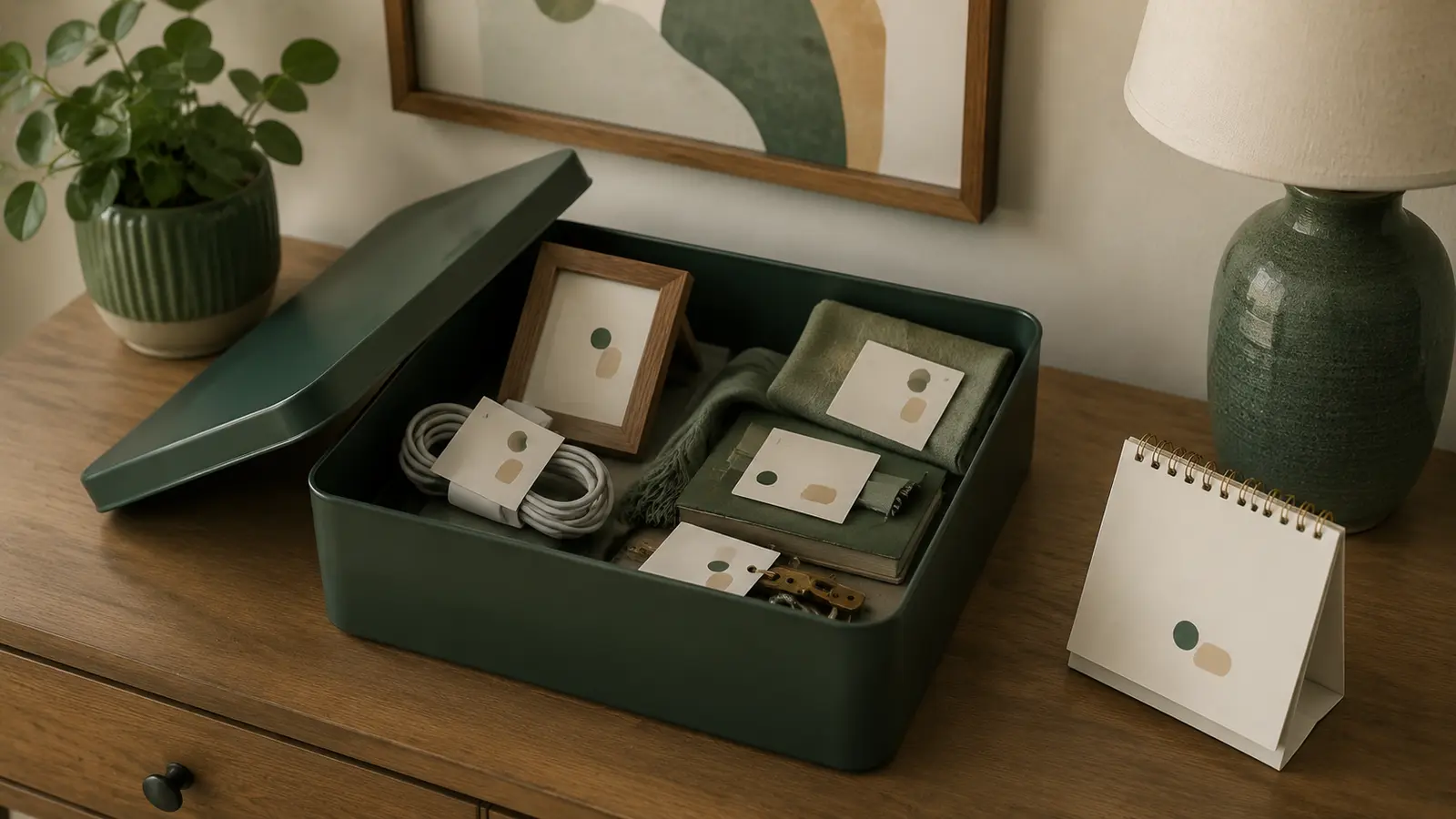
The Dated Decision Box: Handle Uncertain Items Without Hiding Them Forever
Last updated:
Some ordinary belongings cannot be resolved during a quick decluttering session. Information may be missing, another person may need to give permission, or a specific action may have to happen first. A dated decision box contains a small number of these items temporarily while keeping each unresolved question visible and actionable.
What a Dated Decision Box Is
A dated decision box is a small temporary holding place for ordinary items that require a specific unresolved decision. Every item has an exact question, a next action, a responsible person, and a meaningful review date. The fixed boundary prevents the method from spreading through the home.
It is not permanent storage and it is not a general container for everything that feels difficult. Items that already have a safe, known home should return there. Items needing urgent, secure, hazardous, or specialist handling require a different process.
When an Item Qualifies
An item may qualify when the delay has a clear reason and a realistic route toward resolution. Suitable reasons include:
- Information needed for the decision is missing.
- Another owner’s permission is required.
- A repair decision is pending.
- A return destination must be confirmed.
- A short, defined trial is appropriate.
- A specific household decision is already scheduled.
“I do not want to decide now” does not yet provide a route. Turn the uncertainty into a question: which fact, permission, comparison, or action would make the next review useful?
What Should Not Enter the Box
Exclude rubbish or recycling, medication, food, chemicals, hazardous or unknown materials, and anything wet, leaking, contaminated, mould-affected, or pest-affected. Identity documents, urgent papers, and valuables needing secure handling also require appropriate storage rather than a general decision box.
Do not include items with an immediate deadline or belongings that can already be returned to their proper location. Keep sharp, electrical, fragile, or otherwise unsuitable items out unless a safe, specific handling process has been established elsewhere.
Confirm Ownership Before Handling
Identify the owner before moving an item into the box. Never discard, donate, sell, relocate, repair, clean, alter, or otherwise act on another person’s belongings without permission. Shared use does not automatically mean shared authority.
If ownership is uncertain, that becomes the first exact question. Keep the item stable and suitable while asking the relevant people. Do not use a review date as permission to make an unapproved decision later.
Choose a Fixed Physical Boundary
Use an existing suitable box, basket, drawer section, or shelf area. A new product is not required. Choose a boundary that remains safe, stable, accessible, and within its capacity when items are retrieved.
The boundary is a limit, not a target. When it is full, pause additions and review what is already inside. Do not stack items so they fall, overload shelves or containers, or place the box where it blocks normal household function.
Define the Container’s Scope
A clear scope helps the box remain understandable. It may serve one household, one owner, or one related project. Separate boxes are not automatically necessary, but unrelated items should not be mixed when privacy, ownership, fragility, or safe handling would become unclear.
Write the scope on the container or its location note. Examples might be “shared household return questions” or “Victoria’s sewing-project decisions.” The label describes responsibility; it does not reveal confidential information.
Give Every Item a Decision Note
Each item needs a note containing the item, owner, exact question, missing information or permission, next action, responsible person, and review date. Keep the note attached, paired, or otherwise unmistakably linked to the item without damaging it.
“Decide whether to keep” is often too vague. More useful questions are “Does the owner want this returned to the desk drawer?”, “Are all parts present for ordinary use?”, or “Which permitted destination accepts this item in its current condition?” These examples define what must be learned without deciding the outcome for the reader.
Choose a Meaningful Review Date
Base the date on when information, permission, trial use, or another action should reasonably be available. If someone will be present on a particular day, or a suitable repair assessment is scheduled, review after that dependency can be addressed.
Avoid an immediate deadline that leaves no time to complete the action, but do not write an indefinite date. Record the date in a calendar or household system already used. The date is a prompt to review, not an instruction to discard.
Define the Next Action
A next action should be small enough to complete and directly connected to the exact question. It might be asking the owner, checking whether all parts are present, testing ordinary safe use according to instructions, confirming a return destination, or scheduling an appropriate repair assessment.
Other actions may include moving the item to its correct storage location or making an appropriate donation, recycling, or disposal decision. Repair only within the responsible person’s ability, and follow item condition, manufacturer, privacy, and appropriate local guidance. Do not assume a destination accepts an item.
Adaptable Decision-Note Examples
These low-risk examples are adjustable. Confirm ownership, condition, and the actual next step in your home.
| Item type | Exact question | Needed action | Responsible person | Review point |
|---|---|---|---|---|
| Unmatched household cable | Which current device, if any, uses this? | Compare with owned devices without forcing connections | Named owner | After devices are available to check |
| Spare furniture fitting | Does this belong to furniture still in the home? | Check instructions or ask the owner | Furniture owner | After ownership is confirmed |
| Book borrowed within the household | Which person and shelf should receive it? | Ask the likely owner | Named household member | When that person is available |
| Ordinary garment needing repair | Is an appropriate repair assessment wanted? | Ask the owner and inspect care information | Garment owner | After the agreed assessment |
| Small hobby component | Is it part of the current project? | Check the project parts list | Project owner | At the next project session |
| Reusable household container | Does it have a defined use and storage address? | Check current storage need and capacity | Agreed household member | At the scheduled storage review |
A 20-Minute Setup Session
Twenty minutes is a boundary, not a completion guarantee. Stop when the time ends and leave every item safely contained or returned.
- Minutes 0–3: choose the boundary.
- Minutes 3–6: confirm ownership and exclusions.
- Minutes 6–11: select qualifying items.
- Minutes 11–15: write exact questions and actions.
- Minutes 15–18: assign review points.
- Minutes 18–20: store the container safely and record its location.
Keep the Box Visible Without Creating an Obstruction
The box should be visible enough to remember or clearly recorded in a system you already check. It does not need to sit in the centre of a room. Choose a suitable location that supports review without becoming part of the everyday walking route.
Keep exits, ventilation, utilities, heaters, electrical equipment, doors, windows, and walking routes clear. Do not store the box in damp, unstable, inaccessible, or otherwise unsuitable conditions.
Use a Clear Review-Session Sequence
- Bring out only the dated box.
- Read each decision note.
- Complete actions for which information or permission is available.
- Return kept items to suitable storage.
- Move authorised exit items to a defined next destination.
- Rewrite a date only when a real dependency remains.
- Remove empty notes and reset the box.
Work through one item at a time. A review can still be useful when only some questions are resolved. Do not add unrelated decluttering tasks while the box is open.
When the Decision Remains Unclear
Identify what is still missing. Rewrite the question, seek permission or suitable information, reduce the scope of a safe trial, or assign one further dated action. The new note should name the real dependency and who will address it.
Do not extend an item automatically just because the review feels difficult. Equally, do not force an outcome simply because the date arrived. If no useful next action can be named, reconsider whether the box is the right method for that item.
Handle Sentimental Items Respectfully
The box may hold a small, defined set of ordinary sentimental items for later consideration when a specific question or conversation is needed. It should not force quick decisions about meaningful belongings or become unlimited sentimental storage.
Use a respectful question such as who owns the item, what information is missing, or where it can be stored safely. If the topic needs more time than the container’s scope allows, schedule a separate review rather than compressing it into a quick session.
Coordinate the Box in a Shared Home
Use named ownership, consent, and separate decision notes. Agree where the box will be stored, how review reminders will be shared, and who is responsible for each action. Make arrangements accessible to the people involved.
Responsibility should come from agreement, availability, ownership, and ability—not gender. One person may maintain the list without gaining authority over everyone else’s belongings.
Complete the Exit Route
An authorised decision to donate, return, repair, recycle, sell, or dispose is not complete until an exact destination and next step are named. Record who will take the item, where it can appropriately go, and any relevant deadline or condition requirement.
Follow privacy, manufacturer, item-condition, and appropriate local guidance. Confirm acceptance before travelling or transferring an item. Keep exit items safely separated and never act on another person’s property without permission.
Troubleshoot the Decision Box
| Problem | Likely cause | Small adjustment |
|---|---|---|
| The box becomes overfilled | The boundary is treated as expandable | Pause additions and review existing notes |
| Items have no decision notes | Uncertainty was contained without a question | Write a complete note or return the item |
| The review date repeatedly passes | The action or responsibility is unrealistic | Name one smaller action and responsible person |
| Another person adds items | Scope and consent are unclear | Agree on the box rules and ownership |
| Questions remain vague | The missing information is not named | Rewrite one exact answerable question |
| Authorised exit items never leave | No destination or next step exists | Confirm a suitable destination and action |
| Important items are accidentally included | Exclusions were not checked | Remove them to appropriate secure handling |
| The box becomes permanent storage | Reviews do not complete actions | Reset the fixed capacity after each review |
Saveable Dated-Decision Checklist
- Confirm that the item qualifies.
- Check every exclusion.
- Identify ownership and permission.
- Use one fixed safe capacity.
- Write one exact question.
- Name the missing information or permission.
- Define the next action.
- Assign a responsible person.
- Choose a meaningful review date.
- Run the review session.
- Complete any authorised exit route.
- Remove resolved notes and reset the box.
Safety Note
Exclude hazardous, leaking, contaminated, mould-affected, pest-affected, sharp, electrical, or unknown items. Protect documents and valuables with appropriate secure handling. Follow product and manufacturer guidance, do not overload storage, and keep exits, routes, ventilation, utilities, heaters, and electrical equipment clear.
Stop when an item, container, or location is unsafe. Obtain qualified or appropriate local help for hazardous materials, electrical items, contamination, mould, pests, secure documents, or other concerns outside ordinary household handling.
Continue with Decluttering, use a smaller active-space method with the One-Container Declutter, or learn more About Baaydo.

