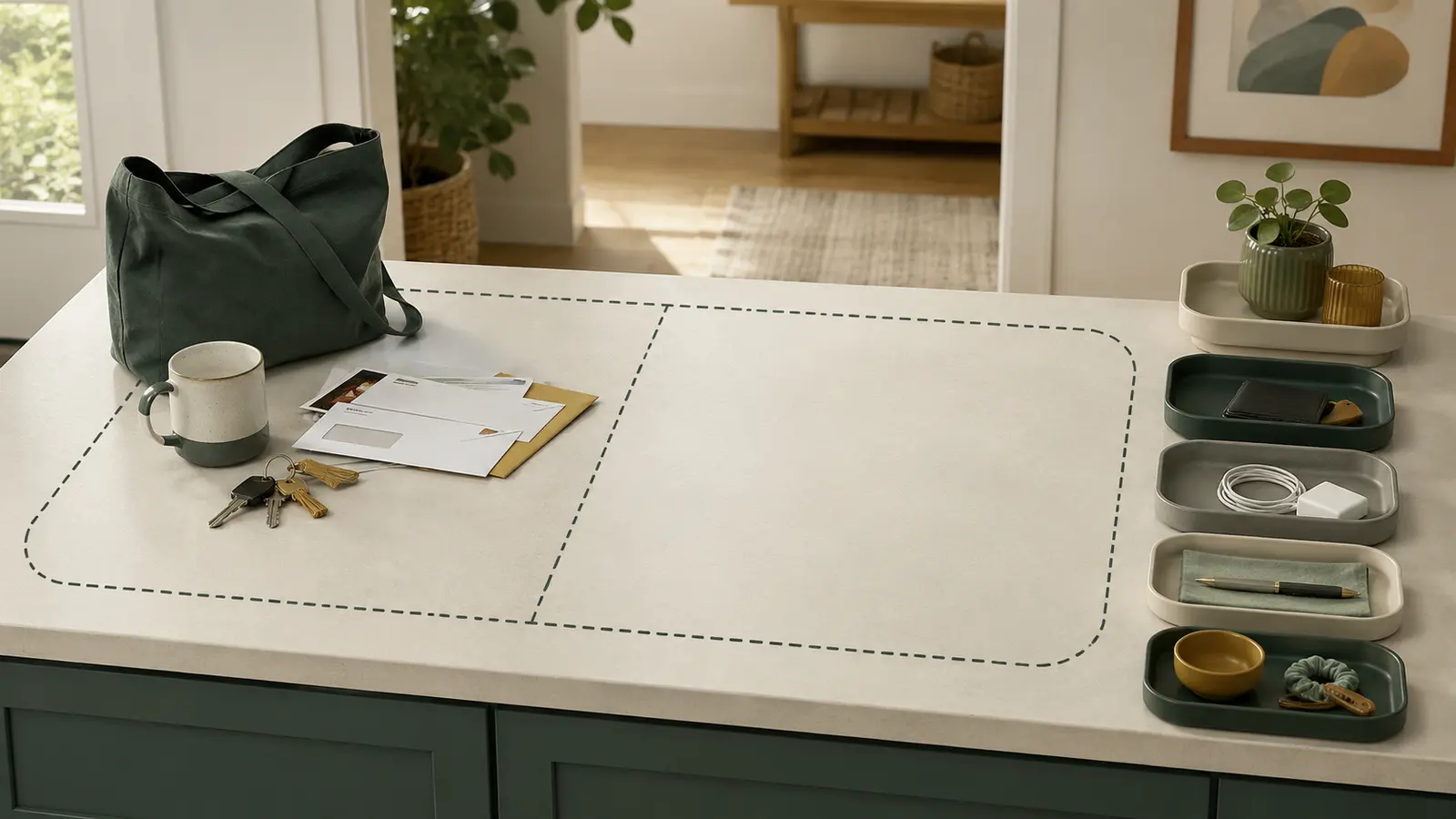
The One-Surface Reset: Clear a Cluttered Counter in 20 Minutes
Last updated:
A cluttered surface can make a whole room feel harder to use. This guide helps you reset one counter, desk, dresser, bathroom counter, or entryway surface in a focused 20-minute session. You will decide what the surface is for, sort what is on it, clean the exposed area safely, and create a simple arrangement you can test for seven days.
Who This Reset Is For
This method is for a single manageable surface, not an entire room. Choose a boundary you can point to: one kitchen counter between two appliances, the top of one desk, one dresser top, one bathroom vanity, or one entryway shelf. Drawers, cupboards, and the floor are separate projects unless an item simply needs to be returned there.
The 20-minute timer is a boundary, not a promise that every surface will be completed. Its purpose is to keep the task contained and help you make visible progress without allowing one surface to expand into a full-room reorganisation. A crowded surface may need a second session, and stopping safely at 20 minutes still counts as completing the planned reset.
Define the Finish Line
Before moving anything, decide what “done for today” means. Choose one surface, name its main purpose, and identify what must remain there. Your stopping point might be “the whole surface is sorted and the centre is clear” or “the left half is reset, and the remaining items are contained for tomorrow.” A clear finish line prevents nearby clutter from quietly joining the project.
Examples for common surfaces
- Kitchen counter: Keep the kettle and the utensil holder; leave enough open space to prepare one meal.
- Desk: Keep the computer, lamp, and current notebook; clear enough space to write on one sheet of paper.
- Dresser: Keep one tray for daily jewellery and one decorative object; remove clothes, receipts, and empty packaging.
- Bathroom counter: Keep the hand soap and the two products used every morning; store occasional items elsewhere.
- Entryway: Keep a key tray and one container for outgoing items; clear the path and the landing area for bags.
If several purposes compete for the same surface, choose the purpose used most often. Write the other needs down rather than solving them during this reset.
Prepare Five Temporary Destinations
Place five bags, baskets, trays, or clearly marked areas beside the surface. These are temporary destinations, not new storage systems.
- Stays here: Items that support the surface’s chosen purpose and have permission to return.
- Belongs elsewhere: Items with an existing home in another room, drawer, cupboard, or shelf.
- Needs action: Bills to pay, objects to repair, forms to complete, returns to make, or anything requiring a specific next step.
- Recycle or discard: Obvious rubbish, empty packaging, expired notices, or recyclable material, handled according to local rules.
- Decide later: Items that genuinely need more thought and would stall the session.
Keep “Decide later” deliberately small—one shallow tray, small box, or envelope. Add a review date within the next seven days. Without a size limit and date, this category can become permanent hidden clutter. Important papers, medication, keys, money, and valuables should not be placed in an unlabelled container.
The 20-Minute Reset
Minutes 0–2: Observe and define the boundary
Start the timer. Photograph the surface for your own reference, or pause and observe it if you do not want a photograph. Name the exact boundary and the function you want the surface to serve. Notice fragile, private, sharp, leaking, hot, electrical, or unknown items before touching anything.
Minutes 2–6: Remove obvious rubbish and recycling
Collect only items that are clearly rubbish or recycling: empty wrappers, junk mail, used tissues, empty containers, and scraps. Check envelopes and packaging before discarding them. Do not make uncertain decisions here; place uncertain items in “Decide later.”
Minutes 6–12: Sort every remaining item
Pick up each remaining item and place it in one of the five destinations. Work from one edge to the other so nothing is skipped. Avoid walking items around the house during this stage. The aim is to complete the surface-level sort before the timer is used up.
Minutes 12–16: Clean the exposed surface appropriately
Remove loose dust or crumbs, then clean only if you know the surface material and the product is suitable for it. Follow the surface and cleaning-product manufacturer instructions, including ventilation, contact time, protective equipment, and drying guidance. Never mix cleaning products. For uncertain finishes, valuable furniture, electronics, or damaged materials, pause and obtain appropriate instructions.
Minutes 16–19: Return only approved items
Return the “Stays here” items according to the finish line you set. Group small daily objects in one tray or container so their boundary is visible. Leave useful open space rather than filling every available centimetre. If an item does not support the surface’s purpose, send it to a more suitable destination.
Minute 19–20: Move temporary groups onward
Take rubbish and recycling to the correct bins. Put the “Belongs elsewhere” group into a return basket or carry it to its existing homes if they are close. Place “Needs action” where you manage tasks, and label “Decide later” with its review date. Do not begin organising another area.
The One-Touch Exception
Sometimes completing a very short task immediately is quicker than tracking it. Closing a pen, putting a lid on a container, or placing a single nearby book on its shelf can be a useful one-touch exception when it takes only a few seconds and does not interrupt the sorting sequence.
The exception becomes a distraction when it starts a new project: reading a letter, answering an email, repairing an object, reorganising a drawer, or walking from room to room. Put those items in “Needs action” or “Belongs elsewhere” and continue the reset. The surface remains the priority until the timer ends.
What to Do When the Timer Ends
- Finished surface: Stop, remove the temporary containers, and use the surface normally. There is no need to improve nearby areas.
- Partly finished surface: Keep the cleared section open. Place unsorted items together in a labelled temporary container and schedule another short session.
- Important documents or valuables: Put them in a secure, clearly identified place. Do not leave identity documents, financial papers, medication, keys, or valuables in rubbish, recycling, or an unlabelled box.
- Another household member’s items: Group them safely and ask the owner what they want done. Never discard or relocate another person’s possessions permanently without permission.
Preventing the Clutter from Returning
Look at what accumulated and ask what action each item was waiting for. Clutter often returns when an item is used on the surface but has no nearby home, when incoming objects have no landing place, or when putting something away requires too many steps.
- Use a small tray for keys, jewellery, or other everyday items.
- Create one defined incoming-paper location rather than several loose piles.
- Keep a return basket for objects that regularly travel to other rooms, and empty it on a set day.
- Add charging storage that keeps cables and devices contained without blocking ventilation.
- Set a limit on decorative objects so the surface retains usable open space.
- Do a two-minute closing reset: remove rubbish, return stray items, and restore the tray boundary.
Choose the smallest adjustment that addresses the repeated cause. Buying more containers before understanding the problem can simply give clutter a larger place to collect.
The Seven-Day Maintenance Test
For seven days, observe the surface once at roughly the same time. Note which items returned, where they landed, and what you were trying to do when you left them there. A brief note such as “mail—no time to sort” or “charger—no nearby drawer” is enough.
At the end of the week, keep arrangements that worked without extra effort. If the same items repeatedly return, revise the system around actual behaviour: move the paper tray closer to the door, make the return basket easier to reach, give the charger a ventilated home, or allow one clearly bounded place for an item that is genuinely used there. Change one feature at a time and test again.
Troubleshooting the Reset
| Problem | Likely cause | Small adjustment |
|---|---|---|
| The surface fills again overnight | Incoming items have no defined landing place | Add one small tray or paper holder at the point of arrival |
| The “Decide later” box keeps growing | There is no review date or size limit | Use a smaller container and schedule a ten-minute review |
| Items belong in several rooms | Returning them interrupts the reset | Use one portable return basket and empty it after sorting |
| Cleaning takes most of the timer | The surface needs specialist or deeper care | Do a safe basic wipe now and schedule suitable cleaning separately |
| Daily items spread beyond their area | The boundary is unclear | Use a tray sized for the allowed daily items |
| Papers remain because each needs action | Storage and task management are mixed together | Create labelled “to pay,” “to file,” or “to reply” folders |
| Decorative objects block useful space | No display limit has been set | Choose a fixed number to display and rotate the rest |
Saveable One-Surface Checklist
- Choose one surface and state its purpose.
- Define what must remain and what “done for today” means.
- Prepare: Stays here, Belongs elsewhere, Needs action, Recycle or discard, and Decide later.
- Set a 20-minute timer and observe the starting state.
- Remove obvious rubbish and recycling.
- Sort every remaining item without starting another project.
- Clean safely according to surface and product instructions; never mix products.
- Return only approved items and keep useful space open.
- Move each temporary group to its next destination.
- Label the small “Decide later” container with a review date.
- Protect documents and valuables, and ask permission before moving another person’s possessions.
- Run the seven-day test and adjust one repeated trouble point.
A Brief Safety Note
Follow manufacturer instructions whenever you clean a surface or use a product. Protect important documents and valuables, and ask permission before moving another person’s possessions. If the surface contains hazardous, sharp, leaking, electrical, or unknown materials, stop and seek appropriate help before continuing.
For related guidance, browse the Decluttering guides or read About Baaydo.

