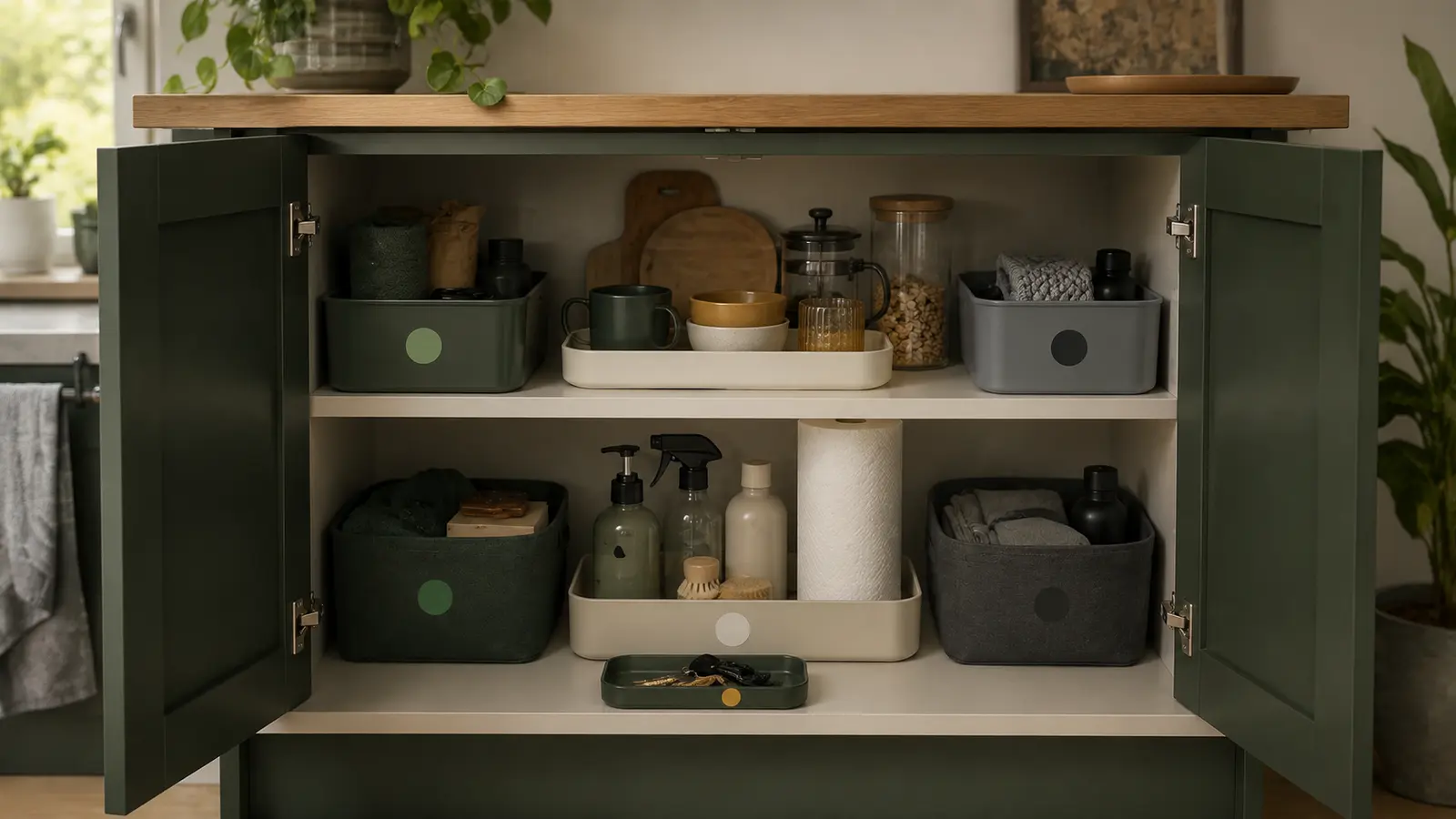
The Shared Storage Agreement: Give Common Cupboards Clear Boundaries
Last updated:
A shared cupboard works better when everyone can predict what belongs there, where it should return, and what requires permission. A shared storage agreement is a simple practical household arrangement for one common area. It is not a legal contract or tenancy agreement, and it does not require every shelf to look equally divided.
What a Shared Storage Agreement Does
The agreement defines the storage area’s purpose, identifies who uses it, separates shared and personal items, allocates usable capacity, explains how additions and removals are handled, and sets a simple reset and review process.
The objective is predictable access. Different people may need different amounts or positions of space because of frequency, reach, mobility, privacy, ownership, or responsibility. A clear working arrangement matters more than equal-looking shelves.
Choose One Low-Risk Shared Area
Begin with one kitchen cupboard, bathroom shelf, entryway cabinet, linen shelf, stationery drawer, or similar low-risk area. Keep the physical boundary narrow enough to review and restore during one session.
Do not begin with medication, chemicals, legal documents, valuables, or hazardous tools. Those require secure, item-specific handling, permissions, and instructions that do not belong in a general shared-storage exercise.
Identify Every User
List everyone who uses the area or needs access to something inside it. Consider ownership, age, safe reach, mobility, schedule, privacy, and frequency of use. Include a person who uses the cupboard only occasionally if their belongings or access needs are affected.
Identical space is not always useful space. One person may need a lower shelf; another may need a clearly private section; shared daily items may need the most accessible position. Discuss needs without ranking whose use matters more.
Classify Items Before Moving Them
- Shared household item: used collectively under an agreed arrangement.
- Personally owned item: belongs to one person and requires their permission.
- Assigned-use item: shared or owned but reserved for a person, purpose, or room.
- Ownership unclear: needs a temporary discussion process.
- Belongs elsewhere: has a known, suitable destination outside this area.
Contain unclear items temporarily in a small defined discussion area. Do not discard them, silently claim them, or move them to an unknown location. Record the question and ask the people involved.
Define the Area’s Job in One Sentence
Write a short functional statement, such as “This cupboard stores everyday shared tableware” or “This shelf holds clean household linens for the adjacent rooms.” Everything kept there should support that function or have an agreed reason for being an exception.
A job statement helps settle placement questions without blaming anyone. If an item serves another activity, identify its appropriate destination. If it must stay despite falling outside the main purpose, record the reason and review trigger.
Confirm the Boundary and Capacity
Identify exactly which shelves, drawer space, cabinet section, or other storage is included. Check the condition of fixtures and follow furniture, shelf, container, building, and product instructions.
Doors and drawers must close normally, shelves must remain within rated limits, and items must be safely retrievable without unstable piles. Leave working room for returning belongings. Capacity is the usable safe space, not every possible gap.
Allocate Zones by Use and Accessibility
Possible zones include shared daily items, shared reserve items, clearly assigned personal areas, occasional items, and a small temporary discussion area. Not every cupboard needs every zone.
Allocate positions according to need, safe reach, frequency, ownership, and the activity—not only equal dimensions. Heavy items need stable suitable support. Frequently used shared items should not be hidden behind occasional stock, and personal zones should remain understandable to everyone affected.
Use Simple Labels or Visible Boundaries
Existing safe materials may be enough to mark a shelf edge, drawer section, or container. A label should describe function or ownership clearly, such as “shared daily stationery,” “Sam’s personal section,” or “discuss before moving.”
Labels are optional when the arrangement is already obvious. Avoid labels that expose private information, damage property, interfere with ventilation or instructions, or create confusion when household members change.
Set Rules for Additions
- Confirm that the item supports the area’s purpose.
- Confirm ownership and authority to place it.
- Check available safe capacity.
- Avoid displacing another person’s belongings.
- Assign a clear location.
- Discuss exceptions before treating them as permanent.
An item should not enter merely because there is a temporary gap. If it has no defined zone, decide whether the area’s job needs changing or whether the item belongs elsewhere.
Set Rules for Removals
Shared rubbish may be handled through the household’s normal agreed process. Personally owned items require permission. Unclear belongings move to the small discussion area rather than disappearing into another room.
Borrowed, confidential, valuable, or urgent items need suitable handling. Hazardous, leaking, damaged, or uncertain items require precautions and relevant guidance. A crowded shelf does not grant permission to discard or relocate someone else’s property.
Adaptable Shared-Storage Agreement
| Decision | Agreed arrangement | Responsible person or group | Review trigger |
|---|---|---|---|
| Purpose | One sentence naming the area’s job | All affected users | The function becomes unclear |
| Shared items | Daily and reserve zones based on use | Users of the shared items | Retrieval or return repeatedly fails |
| Personal zones | Named boundaries respected by others | Each owner and household users | Access or capacity changes |
| Additions | Purpose, ownership, capacity, and location checked | Person adding the item | An exception is requested |
| Removals | Permission and suitable handling required | Owner or authorised person | Ownership is unclear |
| Restocking | Visible reserve, capacity limit, and recording method | Agreed household member or shared method | The trigger is missed or stock exceeds capacity |
| Reset | Items returned to zones and discussion area reviewed | Agreed users | The area no longer supports its job |
A 30-Minute Setup Session
Thirty minutes is a boundary, not a completion guarantee. Stop when time ends, keep items safe, and record any unresolved question.
- Minutes 0–4: choose the area and users.
- Minutes 4–8: define its job.
- Minutes 8–14: identify ownership and item classes.
- Minutes 14–19: confirm capacity and access.
- Minutes 19–24: assign zones.
- Minutes 24–27: write addition and removal rules.
- Minutes 27–30: test retrieval and choose a review point.
Hold Respectful Household Discussions
Use specific observations instead of blame: “The personal section is being blocked” is clearer than “You always take over.” Ask before moving possessions, define the desired outcome, and consider accessibility, age, schedule, privacy, and ability.
Record agreed exceptions so people do not remember them differently. Revisit arrangements that repeatedly fail and change one practical element. Do not assign storage work according to gender or assume one household structure.
Adapt the Agreement for Small and Rented Homes
Use existing storage first and keep changes reversible. In a small home, a single shelf may need several clearly defined functions, but safe access and the main purpose should remain understandable.
Obtain permission before drilling, attaching, or altering the property where required. Never block utilities, ventilation, exits, heaters, electrical equipment, windows, doors, appliance clearances, or walking routes to create more storage.
Fit Restocking Into the Agreement
Shared supplies need a visible reserve, a capacity limit, and a recording method for the agreed restock trigger. Reserve stock should not displace personal zones or hide the active item, and buying more should not replace checking what is already present.
For a fuller method, use the Household Supply Restock System. The storage agreement only defines where the shared supply belongs and how household members record its movement.
Run a Seven-Day Shared-Storage Test
Use the area normally for seven days. Observe whether items return to the correct zone, personal areas are respected, anything remains difficult to reach, one zone fills first, additions follow the rules, ownership stays unclear, and the area’s purpose remains understandable.
Change one arrangement at a time. Adjust a boundary, move one daily group, clarify one rule, or change one responsibility, then continue observing. Avoid rebuilding the whole cupboard before learning which detail caused the problem.
Troubleshoot Shared Storage
| Problem | Likely cause | Small adjustment |
|---|---|---|
| Personal items enter shared zones | Boundaries or purpose are unclear | Mark the personal and shared areas |
| Shared items occupy one person’s area | Shared capacity is insufficient or ignored | Review the shared zone and restore the boundary |
| Nobody returns items | Zones or responsibility are inconvenient | Simplify one return route and agree who resets it |
| Ownership remains unclear | Items are moved without discussion | Use the small discussion area and ask |
| One zone is overfilled | Capacity does not match actual use | Review its contents and one adjacent allocation |
| Frequently used items are inaccessible | Access was assigned by appearance | Move the daily group to suitable reach |
| New supplies exceed capacity | The reserve trigger or limit is unclear | Pause additions and check the visible reserve |
| Household members remember different rules | Exceptions were not recorded | Write a short shared arrangement |
A Five-Minute Shared-Storage Reset
Five minutes is a time boundary. Return shared items to their zones, place personal items in assigned areas without altering them, move unclear belongings to the discussion space, confirm doors and drawers close, and note the first zone needing review. Stop if an item or fixture is unsafe.
Saveable Shared-Storage Checklist
- Identify every user.
- Write the area’s purpose.
- Confirm ownership before moving items.
- Classify shared, personal, assigned, unclear, and misplaced items.
- Check the physical boundary and safe capacity.
- Allocate zones by use and accessibility.
- Agree on addition rules.
- Agree on removal and permission rules.
- Protect personal areas and suitable access.
- Define the reset.
- Choose a review trigger.
- Test one change at a time.
Safety Note
Follow furniture, shelf, container, building, and product instructions and weight limits. Do not overload storage. Keep hazardous products secured as directed and retain original labels. Do not mix products or transfer them into unlabelled containers. Consider children, pets, and accessibility.
Keep exits, ventilation, heaters, utilities, electrical equipment, appliance clearances, and walking routes clear. Stop using an unsafe fixture and seek qualified help for hazards, damage, mounting, electrical concerns, leaks, mould, pests, or unknown materials.
Continue with Home Organization, apply the linked Household Supply Restock System, or learn more About Baaydo.

