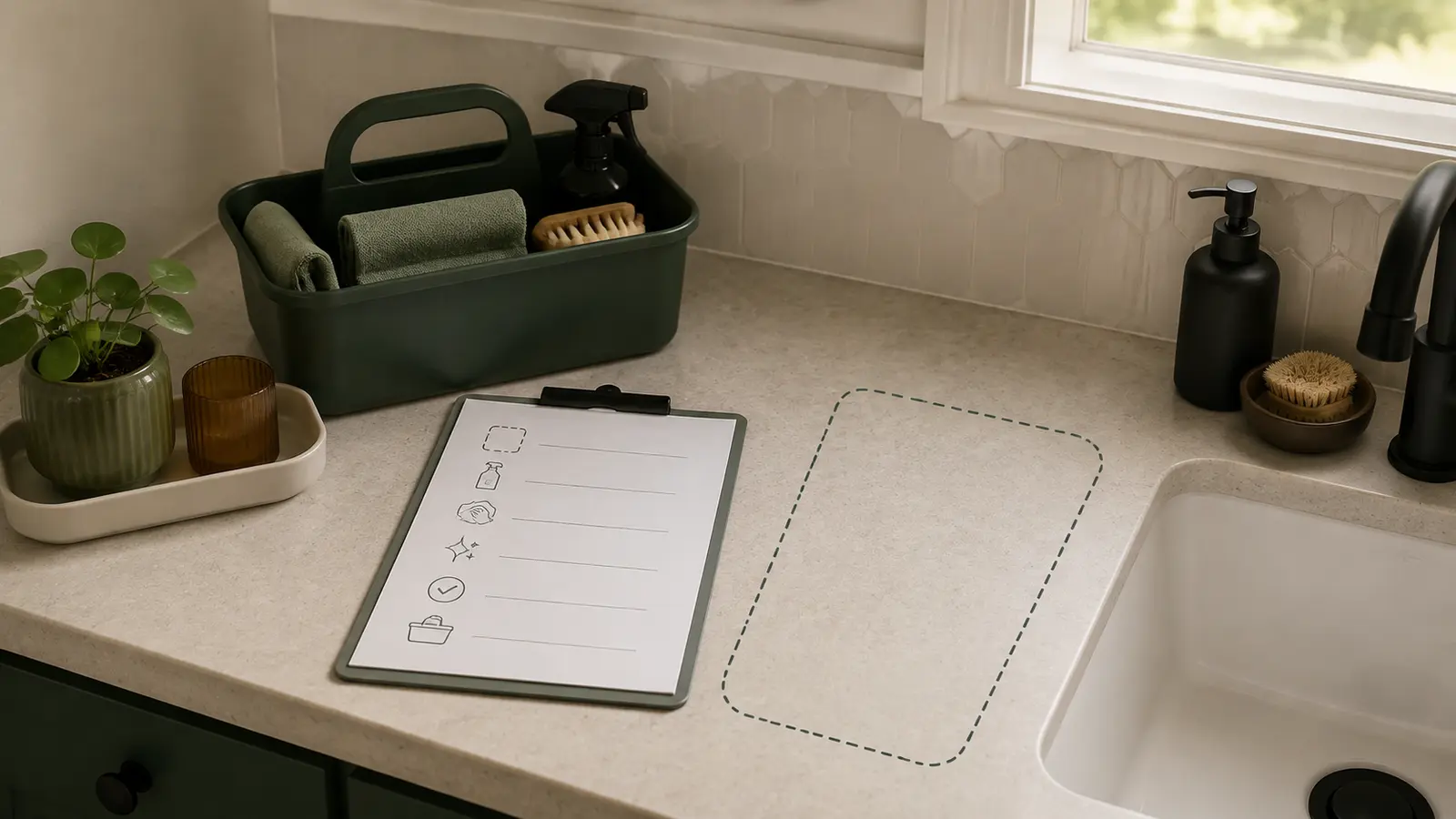
The Cleaning Task Card: Turn a Vague Chore Into a Clear Finish Line
Last updated:
A vague chore can become much larger than expected because nobody knows where it starts, what matters most, or when it is finished. A cleaning task card turns one ordinary maintenance task into a defined sequence with a boundary, trigger, safety check, suitable supplies, finish line, and reset.
Why Vague Chores Expand
Instructions such as “clean the bathroom” or “do the kitchen” do not define scope, priority, or completion. One person may understand the bathroom sink; another may expect the entire room. Work can spread to cupboards, floors, laundry, or possessions that were never part of the original need.
Unclear chores also create disagreement about whether enough was done. A task card replaces assumptions with a small agreed outcome. It may be written on paper, stored in a digital note, or used as an agreed verbal structure. No product or app is required.
The Core Task-Card Fields
- Task name
- Exact area
- Trigger or review point
- Safety check
- Supplies and instructions
- Ordered actions
- Finish line
- Supply and equipment reset
- Person or group responsible
- When to revise the card
A card supports ordinary maintenance. It does not replace product labels, surface-care guidance, manufacturer or appliance instructions, building requirements, or qualified help. If those sources change the safe sequence, follow them rather than the card.
Choose One Low-Risk Ordinary Task
Begin with a contained activity such as restoring a bathroom sink area, clearing a dining surface, preparing a usable kitchen work area, or removing visible ordinary debris from a walking route. Choose something familiar that can be described without specialist handling.
Do not begin with mould, pests, bodily fluids, broken glass, chemicals, electrical problems, leaks, smoke, damaged appliances, contamination, or unknown substances. Stop and use appropriate precautions or qualified help for those conditions.
Define the Exact Boundary
Name the particular surface, fixture, or route included. “Restore the bathroom sink basin and the clear surface immediately beside it” is more useful than “clean the bathroom.” The boundary should be visible or easy to explain.
Also name nearby work that is excluded. The sink card might exclude the bath, toilet, mirror, floor, cupboards, and personal storage. Exclusions prevent the task from absorbing an entire room and protect belongings that require permission.
Choose an Observable Trigger or Review Point
A trigger identifies when the card becomes relevant. Use an event, visible condition, or scheduled check: when the sink is no longer available for its ordinary use, after the final planned use of the surface, or during an agreed review of the route.
Avoid “when dirty.” Different people may interpret it differently, and it does not identify which function is affected. Link the trigger to something observable and early enough that the ordinary task remains manageable.
Write the Safety Check First
Before listing actions, require a brief check for hazards and unfamiliar conditions. Read relevant labels and instructions, confirm ventilation where directed, consider children and pets, and make sure exits, utilities, electrical equipment, and walking routes remain clear.
Stop if the task exceeds ordinary safe cleaning. A task card should never encourage someone to handle a leak, damaged fixture, unknown material, sharp object, electrical concern, or other hazard merely to reach a finish line.
List Only Suitable Supplies
Use generic descriptions tied to instructions: a suitable cleaning cloth, a product approved for the specific surface, ordinary rubbish handling materials, or equipment already permitted for the task. List only what is actually needed.
Follow product, surface, equipment, and appliance instructions. Never mix products or transfer them into unlabelled containers. If the correct supply or instruction is missing, pause the task instead of improvising.
Put the Actions in a Clear Order
- Prepare the defined area.
- Remove or protect unrelated belongings with permission.
- Handle ordinary rubbish appropriately.
- Perform the defined cleaning action.
- Check the finish line.
- Return permitted items.
- Reset supplies and equipment.
This is a planning structure, not a universal cleaning sequence. Relevant labels and instructions control the actual order, contact time, handling, ventilation, and equipment use. Remove any step that is unnecessary for the defined task.
Write an Observable Finish Line
The finish line describes a state that different users can recognise: the sink is available, the required work surface is clear for its next use, ordinary rubbish is contained, the walking route is clear, or permitted equipment has been safely reset.
Avoid promises about cleanliness, hygiene, disinfection, or health. The card should state the household function restored and the safe stopping point. If the finish line requires unrelated work, narrow it.
Add the Supply and Equipment Reset
Finish by returning products to their designated safe storage, handling reusable equipment according to its instructions, removing temporary materials, and keeping routes clear. Retain original labelled containers and secure products from children and pets as directed.
The reset makes the next use possible. If supplies repeatedly remain on the surface or equipment is not ready, the card is missing a practical final action or a suitable storage address.
Adaptable Low-Risk Task-Card Template
This table is an adaptable low-risk example, not a universal cleaning standard.
| Field | Question to answer | Example entry | Revise when |
|---|---|---|---|
| Task name | What single outcome is being restored? | Restore bathroom sink access | The name suggests a larger room task |
| Exact area | What is included and excluded? | Basin and adjacent usable surface; floor excluded | Work repeatedly crosses the boundary |
| Trigger | What observable condition starts review? | Ordinary sink use is obstructed | The task starts too late or too often |
| Safety check | What conditions require a stop? | Stop for leaks, damage, unknown substances, or hazards | A new condition or instruction appears |
| Supplies and instructions | What suitable materials and guidance apply? | Surface-approved product and suitable cloth; follow labels | A surface, product, or instruction changes |
| Ordered actions | What necessary sequence restores function? | Prepare, handle ordinary items, clean as directed, return | Steps conflict or add no value |
| Finish line | What observable state means stop? | Sink and required adjacent area are available | Users disagree about completion |
| Reset | How are supplies and equipment left safely? | Return products and handle cloth as instructed | Supplies remain out |
| Responsibility | Who completes or coordinates the task? | Agreed person or shared arrangement | Access, schedule, or agreement changes |
| Revision point | What signals that the card needs review? | After a safe test or repeated misunderstanding | Any field no longer matches the task |
A 20-Minute Card-Building Session
Twenty minutes is a planning boundary, not a cleaning guarantee. The aim is a usable draft that can be tested safely.
- Minutes 0–3: choose one low-risk task.
- Minutes 3–6: define its boundary.
- Minutes 6–9: choose the trigger.
- Minutes 9–12: identify safety and instructions.
- Minutes 12–15: order the actions.
- Minutes 15–17: define the finish line.
- Minutes 17–19: add the reset.
- Minutes 19–20: choose a review point.
Test the Card Once and Revise It
Use the card once only when the task remains ordinary and safe. Note unclear wording, missing supplies or instructions, unnecessary steps, unrealistic scope, and whether the finish line can be observed. Record the actual points of confusion.
Revise the card rather than blaming the person using it. A missed step may indicate poor order, an inaccessible supply, or an outcome that was never clear. Change the smallest field that addresses the problem.
Use Task Cards Respectfully in Shared Homes
Agree on the scope and outcome. Consider age, ability, schedule, ownership, and accessibility, and request permission before moving possessions. Assign responsibility by agreement rather than gender or assumptions about household roles.
Allow different safe methods when they follow relevant instructions and reach the agreed finish line. A card should coordinate a result, not control every movement. Review it when different users consistently interpret a field differently.
Adapt for Limited Time, Energy, or Mobility
Reduce the boundary, divide actions into safe stages, work seated where suitable, use appropriate accessible tools, ask for a defined form of help, or move non-urgent work to a suitable time. Keep the finish line proportionate to the smaller scope.
Stop if reaching, lifting, balance, ventilation, equipment, or the condition of the area becomes unsafe. This is practical household planning, not medical advice.
When Not to Use a Cleaning Task Card
Do not use an ordinary task card to manage hazards, active damage, contamination, mould, pests, bodily fluids, broken glass, smoke, electrical concerns, leaks, damaged appliances, chemicals, or unknown substances.
Those conditions may require immediate precautions, manufacturer or property guidance, local services, or appropriately qualified help. A routine finish line must not delay a necessary safety response.
Run a Seven-Day Review
- Was the trigger noticed?
- Was the boundary clear?
- Were instructions available?
- Were supplies suitable and safely stored?
- Did actions occur in a useful order?
- Was the finish line observable?
- Was the reset completed?
- Did different users interpret the card consistently?
Change one or two fields before retesting. If the task happens less often, review after enough ordinary uses to observe the same questions without inventing a rigid frequency.
Troubleshoot the Task Card
| Problem | Likely cause | Small adjustment |
|---|---|---|
| The task expands into another room | The boundary or exclusions are unclear | Name the exact surface or route |
| The trigger remains unclear | It relies on judgement | Use one observable event or condition |
| Supplies are missing | The preparation field is incomplete | Confirm suitable supplies before starting |
| Steps occur in conflicting orders | Instructions or sequence are unclear | Follow labels and rewrite the necessary order |
| The finish line is disputed | The result is not observable | Describe the function that should be available |
| The reset is skipped | It is treated as optional | Add storage and equipment actions to the sequence |
| The card takes too long | The scope includes unrelated work | Reduce the boundary or divide stages |
| One household member does every task | Responsibility was assumed | Agree on suitable roles and accessible actions |
Saveable Cleaning Task-Card Checklist
- Name one exact boundary and its exclusions.
- Choose an observable trigger.
- Write the safety check first.
- Confirm relevant labels and instructions.
- List only suitable supplies.
- Put necessary actions in order.
- Describe an observable finish line.
- Add the supply and equipment reset.
- Agree on responsibility and access.
- Test the card once when safe.
- Revise one or two unclear fields.
Safety Note
Follow all product, surface, equipment, and manufacturer labels and guidance. Never mix products. Ventilate where directed and secure products from children and pets. Keep exits, walking routes, ventilation, heaters, utilities, electrical equipment, and appliance clearances unobstructed.
Stop for hazards, active damage, contamination, leaks, smoke, electrical problems, mould, pests, bodily fluids, broken glass, chemicals, damaged equipment, or unknown substances. Seek qualified or appropriate help when needed.
Continue with Cleaning Routines, connect the timing to the Trigger-Based Cleaning Plan, or learn more About Baaydo.

