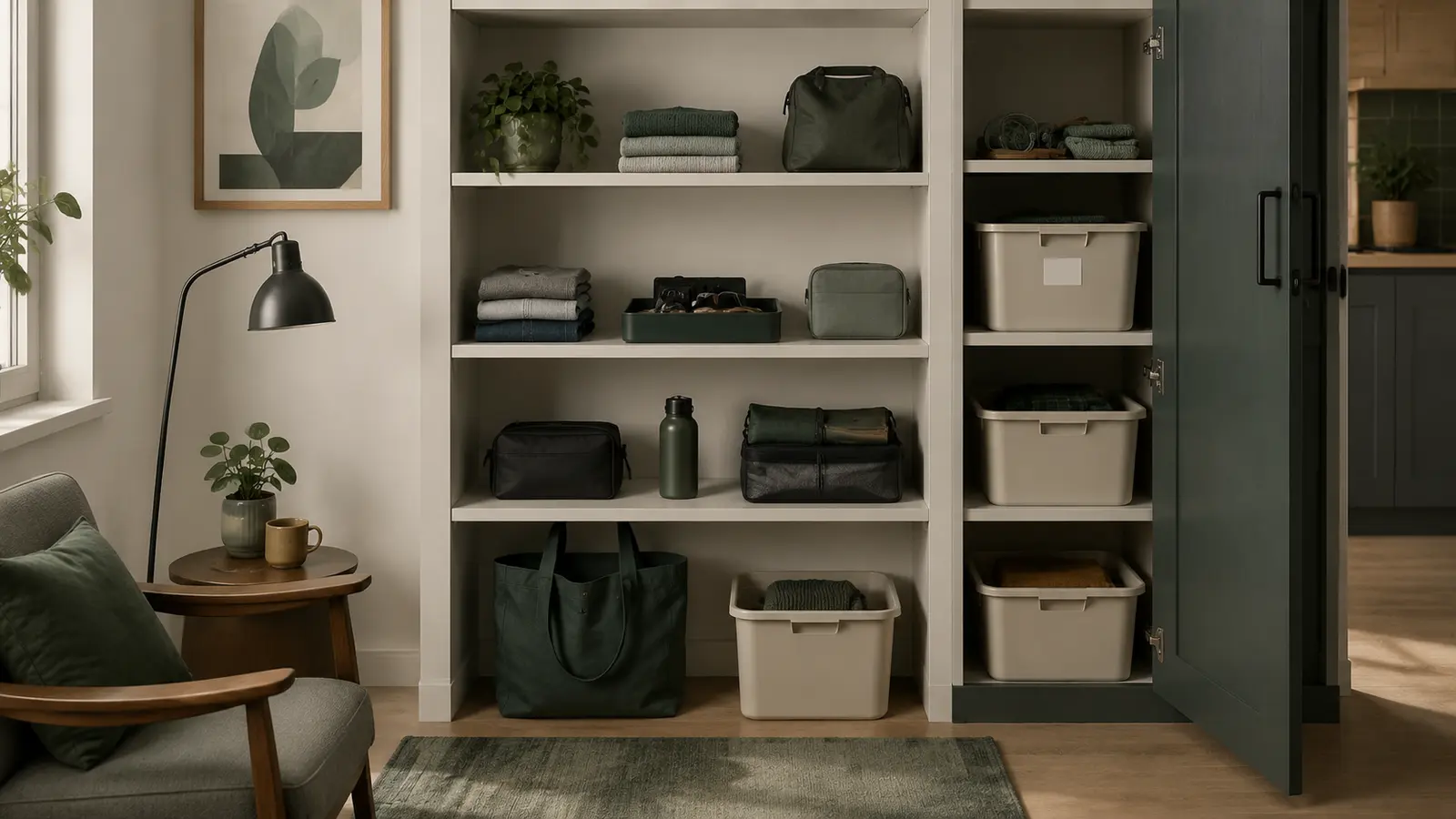
The Small-Space Rotation System: Keep Occasional Items Out of Daily-Use Storage
Last updated:
In a small home, the easiest storage positions need to support current activities. A rotation system moves appropriate occasional belongings out of prime access while keeping them identifiable, safe, and retrievable. Rotation changes which items occupy daily-use storage as needs change; it does not require new containers, rented storage, or discarding possessions.
Why Rotation Helps Limited Storage
Daily-use storage works best when current clothing, tools, supplies, and activity items can be reached and returned without moving unrelated belongings. Occasional items may still be valued and useful, but their presence in prime space can bury what is needed now.
A rotation gives occasional belongings an appropriate location and a reliable return plan. The purpose is not to hide them. A contents record, retrieval trigger, review date, and clear route keep the group connected to future use.
Begin With One Low-Risk Category
Choose seasonal clothing, guest items, decorations, hobby supplies, occasional kitchen or dining items, travel accessories, or suitable sports or outdoor items. Keep the category narrow enough to inspect and record.
Do not begin with medication, food, chemicals, fuels, hazardous tools, emergency supplies, identity documents, legal papers, valuables, or unknown materials. Those need secure, time-sensitive, regulated, or item-specific handling outside an ordinary rotation system.
Define Active and Occasional Groups
- Active now: supports a current activity or need.
- Known future need: linked to an expected event or condition.
- Occasional but relevant: used infrequently without a fixed date.
- Needs action: requires repair, permission, or another decision.
- Belongs elsewhere: has a suitable destination outside this rotation.
“Seasonal” depends on location, climate, household needs, work, culture, and individual routines. Use actual conditions rather than a universal calendar.
Confirm Ownership Before Moving Anything
Identify who owns each item and who uses it. Never store, donate, sell, discard, relocate, repair, or alter another person’s belongings without permission. Shared space does not create authority over personal property.
If ownership is unclear, separate the item in a small discussion area and record the question. Do not include it in a rotation group until the responsible people agree.
Check Condition and Instructions
Inspect items within ordinary safe handling and read care, product, material, equipment, or manufacturer instructions. Prepare each item appropriately for the proposed storage conditions.
Do not store wet, leaking, contaminated, mould-affected, pest-affected, damaged, or unknown items with ordinary belongings. Keep them separate, avoid spreading the problem, and seek appropriate guidance when needed.
Set a Fixed Rotation Capacity
The available safe storage boundary limits the group. Define the exact shelf, cupboard section, furniture space, or suitable existing container included. Do not expand the category merely because more items could be compressed into it.
Do not overload shelves, cupboards, furniture, or containers. Doors and drawers should operate, stacks should remain stable, and items should be retrievable without collapse or unsafe lifting.
Choose an Appropriate Occasional Location
Evaluate manufacturer and care instructions, temperature and moisture, ventilation, weight and stability, child and pet safety, accessibility, the retrieval route, rental or shared-home restrictions, and protection from damage.
There is no universal location. Avoid unsafe overhead storage, overreaching, and any position that blocks exits, utilities, ventilation, heaters, electrical equipment, doors, windows, or another person’s belongings.
Create a Contents Record
Each rotation group should show its category, owner, general contents, storage location, retrieval trigger, review date, and any handling note. Use paper, an existing digital note, or a safe label already available; no particular app or new product is required.
Keep the description useful without exposing private details. “Travel accessories—Alex—wardrobe upper section—retrieve before confirmed travel” is clearer than “miscellaneous box.” Update the record whenever contents or location change.
Define a Specific Retrieval Trigger
Connect retrieval to an upcoming activity, a change in household need, an observable condition, or a scheduled review. Examples include a confirmed guest visit, a planned hobby session, or a household review before a known event.
Avoid “sometime later.” The trigger should tell a responsible person when to check the group without prescribing a universal season or frequency.
Complete the Storage Exchange
- Identify what becomes inactive.
- Retrieve the needed group safely.
- Confirm condition and applicable instructions.
- Move active items into suitable daily storage.
- Prepare inactive items appropriately.
- Update the contents record.
- Keep the route and storage area clear.
An exchange should not leave both groups occupying prime storage. Finish the return route, or pause with items safely contained until it can be completed.
Adaptable Rotation Table
| Rotation category | Active location | Occasional location | Retrieval trigger | Review question |
|---|---|---|---|---|
| Seasonal clothing | Suitable daily wardrobe area | Instruction-appropriate storage | Household need or conditions change | Does this group match current use and condition? |
| Guest items | Prepared guest-use location | Suitable identified storage | A visit is confirmed | Are the items still relevant and ready? |
| Decorations | Current display location | Protected occasional storage | The planned occasion approaches | Is each item suitable to retrieve and use? |
| Hobby supplies | Current activity area | Safe project storage | A project session is planned | Are contents identifiable and complete enough? |
| Occasional dining items | Accessible dining storage when needed | Suitable secondary cupboard area | A relevant meal or event is planned | Does the group justify its capacity? |
| Travel accessories | Current preparation area | Identified occasional storage | Travel is confirmed | Are ownership and contents still clear? |
| Suitable outdoor items | Current point of use | Material-appropriate storage | The activity becomes current | Is condition and safe access acceptable? |
A 30-Minute Planning Session
Thirty minutes is a planning boundary, not a completion guarantee. Stop safely and record the next step if the exchange is unfinished.
- Minutes 0–4: choose one category.
- Minutes 4–8: identify active and occasional items.
- Minutes 8–13: confirm ownership and condition.
- Minutes 13–18: define safe capacity and location.
- Minutes 18–23: create the contents record.
- Minutes 23–27: define retrieval and review triggers.
- Minutes 27–30: test the retrieval route.
Keep the Retrieval Route Practical
Do not bury frequently needed items behind the rotation group, block other storage, require unsafe lifting, or make another person’s belongings inaccessible. The route should allow the responsible person to reach, inspect, and return the group safely.
If retrieval requires moving several heavy or unrelated groups, reduce the category or choose a more appropriate permitted location. Convenience does not override safety or ownership.
Work With Almost No Secondary Storage
Reduce the rotation category, use existing safe storage more precisely, and keep fewer occasional items in prime space. Ask permission before using shared storage and check whether suitable items already have another appropriate destination.
Do not pressure yourself to buy storage or discard belongings. A smaller, clearly recorded rotation may provide enough daily access without creating a large secondary system.
Plan for Shared and Rented Homes
Record named ownership, agree on capacity, keep arrangements removable where appropriate, and obtain permission before alterations. Make storage accessible to the people responsible for retrieval and protect other users’ space.
Assign responsibility by agreement, schedule, ability, and ownership—not gender or household assumptions. Rental, building, and manufacturer restrictions take priority over a preferred storage layout.
Review Each Group
At the retrieval or review point, ask whether each item remains relevant, usable, safely stored, identifiable, and worth the space assigned to it. Update ownership, contents, instructions, and location records where needed.
Repair, donation, recycling, sale, or disposal requires an exact next action, permission, and appropriate condition, privacy, manufacturer, or local guidance. A review date does not force an exit decision.
Troubleshoot the Rotation System
| Problem | Likely cause | Small adjustment |
|---|---|---|
| Contents cannot be remembered | The record is too vague or outdated | Update the general contents and owner |
| The retrieval trigger is vague | No event or review point is named | Link it to one observable condition |
| Daily items remain buried | Occasional stock still occupies prime access | Complete one storage exchange |
| Rotation storage is overfilled | Capacity was treated as expandable | Pause additions and reduce the group |
| Items return in unsuitable condition | Condition checks or instructions were skipped | Inspect and prepare before storage |
| Another person cannot access belongings | The route crosses their space | Restore access and agree on capacity |
| Containers or stacks are too heavy | Weight was not considered | Reduce the group and get appropriate help |
| Occasional items never receive review | No meaningful review trigger exists | Add a dated household review point |
A Five-Minute Rotation Check
Five minutes is a boundary. Confirm the category and owner, check that active and occasional groups remain distinct, inspect the location for obvious problems without unsafe handling, verify the contents record and trigger, and clear the retrieval route. Record one action rather than unpacking everything.
Saveable Rotation Checklist
- Choose one low-risk category.
- Confirm ownership and permission.
- Separate active, occasional, action, and misplaced items.
- Check condition and instructions.
- Set a fixed safe capacity.
- Choose an appropriate storage location.
- Create an accurate contents record.
- Name a specific retrieval trigger.
- Add a meaningful review date.
- Protect clear, accessible retrieval.
- Complete each storage exchange.
- Review one change at a time.
Safety Note
Follow product, material, furniture, shelf, and container instructions and weight limits. Do not climb on unsuitable furniture. Get help with heavy or unstable items. Consider children, pets, accessibility, rental restrictions, and shared ownership.
Keep exits, ventilation, heaters, electrical equipment, utilities, doors, windows, and routes clear. Seek qualified help for structural, electrical, moisture, mould, pest, contamination, or unknown-material concerns.
Continue with Small-Space Living, assign prime access with the Small-Space Storage Priority Ladder, or learn more About Baaydo.

