 TroubleshootingWhy your naan does not puff on the tawa (and how to fix it)
Why your rasmalai turns hard, chewy or rubbery
Rubbery rasmalai ruins dessert. Learn the chenna mistakes behind hard discs and how to get melt-soft results.
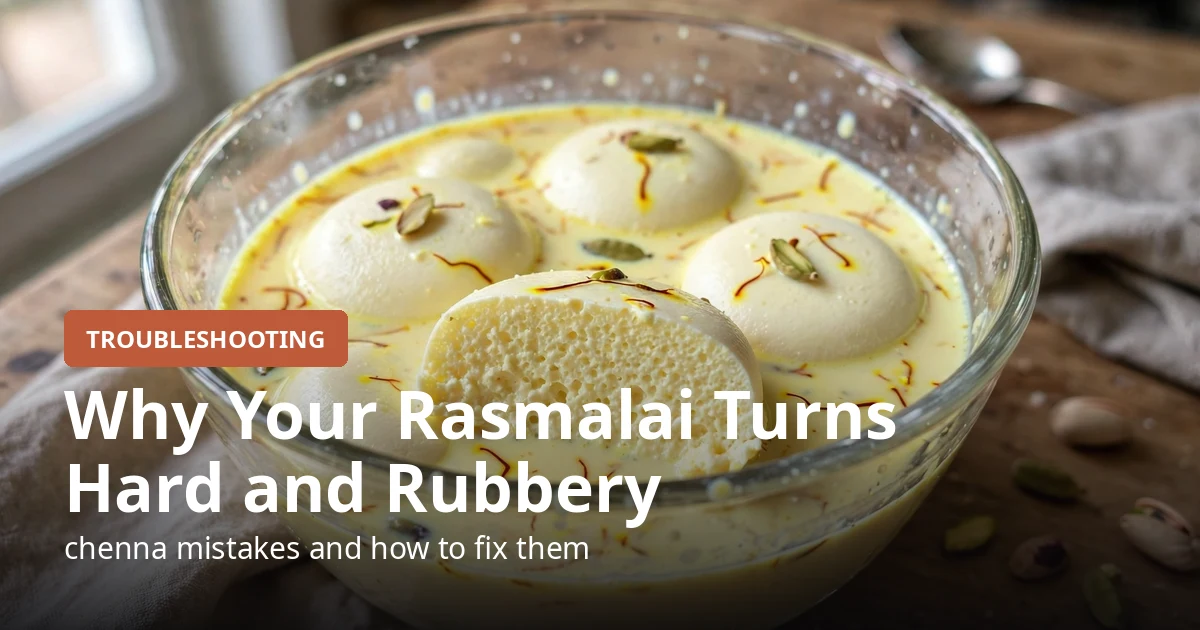

Milk proteins change character the moment acid meets hot milk. Casein, the main protein in milk, locks into curds when the pH drops below 4.6, its isoelectric point. That single chemical moment decides whether your rasmalai melts on the tongue or fights your teeth. Most home cooks lose the battle long before the syrup pot, during the curdling and kneading steps that build the chenna discs. Hard or rubbery discs always trace back to three mistakes: milk that was too hot at curdling, chenna kneaded badly, or syrup with the wrong strength. This guide breaks down each failure point and gives you a tested method for soft, spongy discs. Keep reading to diagnose your exact mistake.
The problem
Perfect rasmalai feels like sweet, fragrant foam against the tongue. The disc yields at once, then dissolves into the saffron milk. That is the standard every home cook chases, and it makes failure sting twice as hard. A hard rasmalai disc resists the spoon. You press, and it bounces back. A chewy disc sticks between the teeth and demands actual work. A rubbery disc squeaks faintly when you bite it, a texture no dessert should ever have. The frustration runs deeper than texture alone. Rasmalai takes hours: curdling milk, hanging chenna, kneading, boiling discs in syrup, then soaking in flavored milk. Guests expect it at weddings, Eid gatherings, and Diwali tables. When the batch turns out tough, the cook has invested a whole afternoon and has nothing to show. Many cooks blame the recipe and switch to another one, only to meet the same rubbery result. The recipe was never the problem. Three preparation errors repeat across nearly every failed batch, and this guide targets each one directly.
Common causes
- Curdling the milk at a rolling boil. Many cooks pour acid into milk at 212 degrees Fahrenheit. Boiling heat shocks the casein and squeezes the curds tight before they even settle. Tight curds release too much whey and lose the moisture that later makes discs spongy. Curdle at 170 to 175 degrees Fahrenheit instead, when the milk steams strongly but never boils.
- Kneading the chenna for the wrong length of time. Chenna needs 8 to 10 minutes of firm kneading with the heel of the hand. Less kneading leaves fat pockets that make discs crumbly and fragile in syrup. More kneading melts the fat out of the protein network and creates a dense, rubbery disc. The test is simple: press a small ball flat and check the surface for cracks.
- Cooking the discs in syrup that is too heavy or too cold. Discs expand in thin syrup because steam escapes easily from a loose liquid. Syrup above 30 percent sugar concentration grips the disc and blocks expansion. Cold syrup shocks the hot chenna and tightens the surface at once. Keep the syrup at a gentle simmer and use a ratio of 4 cups of water to 1 cup of sugar.
- Letting the curds sit too long before kneading. Chenna that rests more than 30 minutes after hanging firms up and dries at the edges. Dry edges refuse to blend during kneading and create hard spots inside the disc. Hang the chenna for 30 to 45 minutes until it stops dripping, then knead it immediately while it still feels moist.
How to fix it
- Boil 2 liters of whole milk, remove it from the heat, and let it cool for 5 minutes until it reaches about 175 degrees Fahrenheit.
- Dilute 3 to 4 tablespoons of lemon juice in half a cup of water and stir it in slowly until clear whey separates from soft white curds.
- Strain the curds through muslin at once and rinse them under cool water to stop the acid from cooking the protein further.
- Hang the chenna for 30 to 45 minutes until it stops dripping but still feels moist to the touch.
- Knead the chenna with the heel of your hand for 8 to 10 minutes until it turns completely smooth.
- Press a small ball flat and confirm the surface shows zero cracks before shaping the rest.
- Shape discs 2 inches wide and half an inch thick with smooth edges.
- Bring 4 cups of water and 1 cup of sugar to a steady simmer and slide the discs in gently.
- Cover and cook for 12 to 15 minutes until the discs double in size.
- Transfer the discs to cold water for 5 minutes to stop carryover cooking, squeeze them gently, and soak them in chilled saffron milk for at least 4 hours.
Pro tips
- Use whole milk with at least 3.5 percent fat. Skim milk produces fragile discs that tear in syrup.
- Warm your hands under hot water before kneading. Warm hands soften the fat faster and smooth the chenna sooner.
- Add 1 teaspoon of cornflour or sooji per 250 grams of chenna if your discs keep breaking in syrup.
- Test a single disc in the syrup before adding the full batch. One test disc saves the whole batch.
- Chill the finished rasmalai overnight. The long soak softens the discs further and deepens the saffron flavor.
FAQs
Can I use store-bought paneer for rasmalai?
No. Store-bought paneer has aged on the shelf and lost the moisture that discs need to expand. Make fresh chenna for every batch and use it within the hour.
Does lemon juice make the discs taste sour?
No. Rinsing the curds under cool water washes the acid away completely. The finished disc tastes sweet and clean.
Do discs shrink because of bad chenna?
No. Shrinkage signals syrup that was too heavy or heat that was too high. Thin the syrup to the 4 to 1 ratio and keep the simmer gentle instead of rolling.
Can I fix hard discs after cooking them?
Yes. Soak the discs in warm milk for 30 minutes. They absorb liquid and soften somewhat, though they never reach the texture of a correctly made batch.
Is baking soda necessary for soft discs?
No. A pinch of baking soda helps some cooks, but correct kneading alone produces soft discs. Master the 8 to 10 minute knead and skip the soda.
Conclusion
Soft rasmalai comes from three controlled moments: curdling near 175 degrees Fahrenheit, kneading for a full 8 to 10 minutes, and simmering discs in light syrup. Master those three moments and the rubbery batches disappear. Your next batch will melt exactly the way rasmalai should.
Related topics
['TroubleshootingWhy your naan does not puff on the tawa (and how to fix it) ', ' TroubleshootingWhy your samosas break open while frying
 TroubleshootingWhy your seekh kebabs fall off the skewer
TroubleshootingWhy your naan does not puff on the tawa (and how to fix it)TroubleshootingWhy your samosas break open while fryingTroubleshootingWhy your seekh kebabs fall off the skewer
Comments
Comments are saved in your browser only.