 TroubleshootingWhy your samosas break open while frying
Why your naan does not puff on the tawa (and how to fix it)
Naan refuses to puff on your tawa? Learn the heat, dough and technique fixes that give you balloon-soft naan without a tandoor.
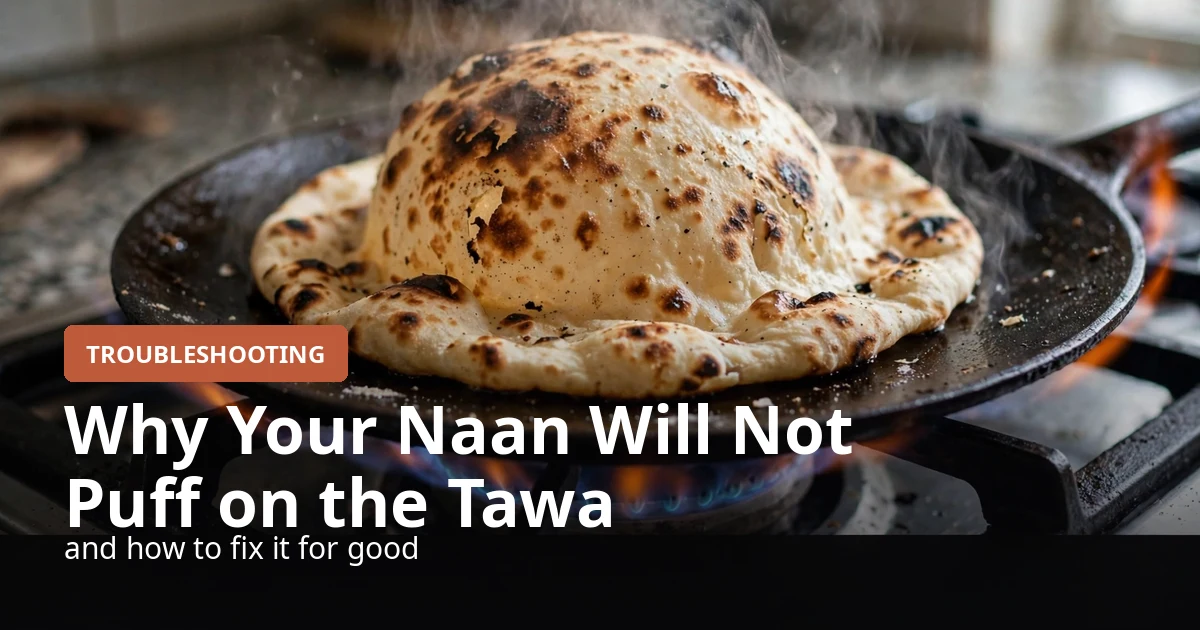

A tandoor wall reaches about 480 degrees Celsius. That wall of heat turns water inside the dough into steam within seconds. The steam pushes the naan outward and creates the famous balloon. A home tawa never reaches that temperature. Most home gas burners deliver far less heat to the cooking surface. Infrared readings show home tawas often sit 150 to 200 degrees below tandoor walls. This gap explains the flat naan problem. You can still get a full puff without a tandoor. The fix lives in dough hydration, rest time, rolling thickness, and flip timing. Each variable pushes the dough closer to a full balloon. Keep reading to learn the exact method.
The problem
You mix the dough, roll the naan, and slide it onto a hot tawa. Nothing happens. The naan lies flat, picks up a few pale spots, and turns chewy instead of airy. You flip it. You press it with a cloth. The result looks like a thick chapati. It tastes fine, but it never balloons. This failure frustrates home cooks because naan looks simple. The ingredient list stays short. The shaping takes minutes. In a restaurant, the tandoor does the work. At home, the tawa must do the work. Many cooks blame the pan. Some blame the flame. A few buy heavier cast iron and see no change. The real causes sit earlier in the process. They sit in the dough formula, the rest, and the heat management. Fix those three, and the same tawa produces a full puff.
Common causes
- Low dough hydration. Naan dough needs 60 to 65 percent water relative to flour weight. For 500 grams of flour, that means 300 to 325 milliliters of water. Dry dough holds little water. Little water means little steam. Little steam means no puff.
- Short rest time. Yeast needs 90 to 120 minutes to inflate the dough fully. A 30 minute rest leaves the gluten network weak. Weak gluten cannot trap steam. The gas escapes through the surface instead of lifting it.
- Uneven rolling. The ideal thickness is 4 to 5 millimeters across the whole naan. Thick patches resist steam pressure. Thin patches cook through before steam builds. The result is a half puff or no puff at all.
- A tawa that is not hot enough. The tawa needs 5 to 7 minutes of preheating on the highest flame. A lukewarm tawa cooks the dough slowly. Slow cooking dries the surface before steam forms inside. Test with water drops. The drops should dance and vanish within 2 to 3 seconds.
- Flipping too early. The first side needs 60 to 90 seconds of undisturbed contact. Early flipping breaks the forming steam pockets. Each extra flip presses out more gas. One flip gives the best puff.
- Heavy flour dusting. Excess dry flour on the surface acts as insulation. It blocks direct heat transfer into the dough. Brush off loose flour before the naan hits the tawa.
How to fix it
- Mix 500 grams of all purpose flour with 310 milliliters of lukewarm water, 7 grams of instant yeast, 10 grams of salt, 15 grams of sugar, 30 grams of plain yogurt, and 15 milliliters of oil. This gives about 62 percent hydration.
- Knead for 8 to 10 minutes until the dough turns smooth and elastic. The dough should stretch without tearing.
- Cover the bowl and rest the dough for 90 to 120 minutes at warm room temperature. The dough should double in size.
- Preheat a cast iron tawa on the highest flame for 5 to 7 minutes. Flick water drops on the surface. They should dance and evaporate in 2 to 3 seconds.
- Divide the dough into 100 gram balls. Roll each ball to an even 4 to 5 millimeter thickness. Shake off loose flour.
- Lay the naan on the tawa. Leave it untouched for 60 to 90 seconds. Watch for small bubbles on the surface.
- Flip once. Press gently around the edges with a folded dry cloth. The trapped steam will push the center upward into a balloon.
- Cook the second side for 45 to 60 seconds. For char spots, lift the naan with tongs and hold it 10 to 15 seconds directly over the flame.
Pro tips
- Brush a thin film of water on the top surface before flipping. The moisture turns into extra steam under the heat.
- Cover the naan with a large domed lid for 20 to 30 seconds after flipping. The trapped steam speeds the puff.
- Keep rolled naans under a damp cloth. A dry skin blocks the balloon.
- Use a cast iron tawa instead of thin non stick. Cast iron holds heat between naans.
- Never prick the dough with a fork. Holes release the steam you need.
FAQs
Can I get a puff without yeast?
No. Yeast builds the gas network that steam expands. Baking powder gives a partial lift, but it cannot match a full yeast balloon.
Does a non stick tawa work for naan?
Yes. A non stick tawa works, but it loses heat faster than cast iron. Preheat it fully and cook one naan at a time for the best result.
Why does my naan puff and then collapse?
Yes, a quick collapse is normal. Steam escapes as the naan cools. Serve the naan within 2 minutes of cooking to enjoy the full balloon.
Why do the edges burn before the center puffs?
Uneven thickness causes this. The thin edges cook fast while the thick center lags. Roll the naan to an even 4 to 5 millimeters and the timing lines up.
Conclusion
The tawa can match the tandoor when the dough and the heat work together. Hydrate at 62 percent, rest for 2 hours, preheat hard, and flip once. The next naan will balloon. Serve it hot.
Related topics
['TroubleshootingWhy your samosas break open while frying ', ' TroubleshootingWhy your seekh kebabs fall off the skewer
 TroubleshootingWhy your shami kebabs break while frying
TroubleshootingWhy your samosas break open while fryingTroubleshootingWhy your seekh kebabs fall off the skewerTroubleshootingWhy your shami kebabs break while frying
Comments
Comments are saved in your browser only.