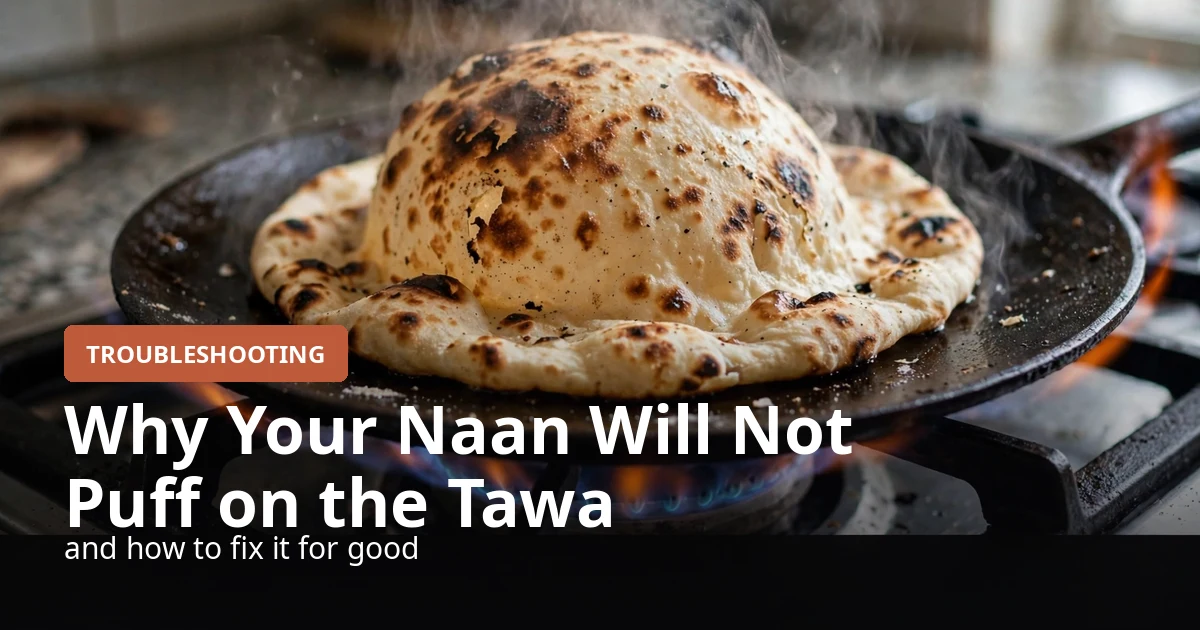
 TroubleshootingWhy your naan does not puff on the tawa (and how to fix it)
Why your roti does not puff up
Flat rotis are a steam problem, not a skill problem. This guide covers hydration, resting, tawa heat and rolling for full puffs.
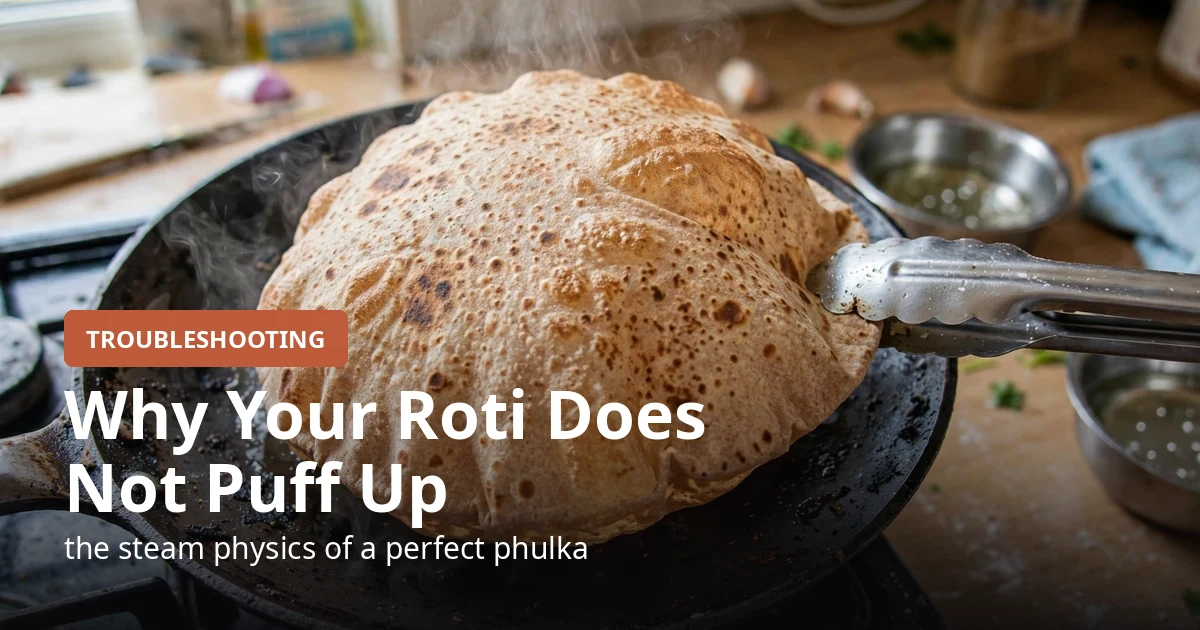

Water turns to steam at 212 degrees Fahrenheit, and steam occupies roughly 1,700 times the volume of liquid water. That explosive expansion is the entire engine behind a puffed roti. The dough traps a thin film of water between its two pressed layers, the heat of the tawa flashes that water into steam, and the steam inflates the roti like a balloon. When a roti refuses to puff, the failure is always physical, never mysterious: the dough held too little water, the rest was too short, the tawa ran too cool, or the rolling pressed the layers together. This guide explains the steam physics in plain terms and shows how to fix each link in the chain. Keep reading to make every roti balloon.
The problem
A flat roti tastes fine, but a puffed roti tastes like a small victory. The puffed pocket steams the inside layer soft while the outside stays tender, and the whole bread feels lighter in the mouth. Every home cook knows the disappointment of flipping a roti again and again while it lies stubbornly flat. The disappointment sharpens at the dinner table, because rotis arrive in a stack and the flat ones sit there as visible evidence. Family members peel them open, find no pocket, and the cook feels judged by a piece of bread. Many cooks blame the flour brand and buy another bag, or they press harder with the rolling pin, which makes the problem worse. Rolling cannot fix a dough that lacks water or rest. Puffing is a chain reaction, and one weak link stops it cold. This guide walks through every link so you can find yours.
Common causes
- Dough mixed too dry. Puffing needs free water inside the dough to flash into steam. Dough mixed with too little water, or with cold water added too fast, forms a tight crumb with no moisture reserves. The roti heats through but nothing inside turns to steam. Use lukewarm water and add it gradually until the dough feels soft and slightly tacky, like a relaxed earlobe.
- Skipping the resting period. Freshly kneaded dough has a tight gluten network that resists expansion. Steam pushes against stiff gluten and leaks out the edges instead of inflating the pocket. Resting for 20 to 30 minutes relaxes the gluten and lets the flour hydrate fully. Cover the dough with a damp cloth so the surface never dries.
- A tawa that is not hot enough. The flash of steam needs sudden, fierce heat. A lukewarm tawa warms the roti slowly, and the water escapes as gentle vapor long before pressure builds. Heat the tawa for 3 to 4 minutes until a drop of water dances and evaporates in 2 seconds. Cook each side just 30 seconds before moving to the direct flame or the second flip.
- Uneven rolling that seals the edges. Thick centers and paper-thin edges, or edges pressed harder than the middle, let steam leak out instead of collecting in the pocket. Roll from the center outward with light, even pressure, rotate the roti a quarter turn between rolls, and keep the thickness uniform at about 2 millimeters.
- Flipping too late on the first side. The first side needs only 20 to 30 seconds, just until small bubbles appear. Waiting longer dries the surface and sets the starch, which stiffens the layers. A stiff roti cannot inflate. Watch for the first bubbles and flip immediately.
How to fix it
- Measure 2 cups of whole wheat flour into a wide bowl.
- Add 3/4 cup of lukewarm water gradually, mixing with your fingers until a shaggy dough forms.
- Knead for 6 to 8 minutes until the dough turns smooth and springs back when poked.
- Cover with a damp cloth and rest for 25 minutes. Do not skip this step.
- Heat a cast iron or heavy tawa on medium-high for 4 minutes. Test with a water drop.
- Pinch a lemon-sized ball, dust it lightly with dry flour, and roll it to a 6-inch circle of even thickness.
- Lay the roti on the hot tawa. Cook the first side for 25 seconds until small bubbles appear.
- Flip and cook the second side for 30 seconds until light brown spots form.
- Flip once more and press the edges gently with a folded cloth or tongs. The roti should balloon within 10 seconds.
- If you cook over a gas flame, lift the roti with tongs and hold it directly over the flame for 5 seconds to finish the puff.
Pro tips
- Add 1 teaspoon of oil per 2 cups of flour during kneading. The oil tenderizes the crumb and improves puffing.
- Roll the roti slightly thicker in the center. A 2-millimeter center with 1.5-millimeter edges traps steam best.
- Keep a stack of cooked rotis wrapped in a clean cotton cloth inside a closed container. The trapped steam keeps them soft for an hour.
- Dust off excess dry flour before the roti hits the tawa. Burnt flour leaves bitter black spots.
- Make the dough 30 minutes before dinner, not hours ahead. Over-rested dough turns slack and puffs poorly.
FAQs
Does the flour brand decide whether rotis puff?
No. Any fresh whole wheat atta puffs when the dough holds enough water and gets enough rest. Old or damp flour hurts results, but the brand name matters far less than technique.
Can I puff rotis on an electric stove?
Yes. Electric coils work fine if you heat the tawa fully and press the edges with a cloth on the final flip. Without an open flame, the cloth-pressing step matters even more.
Why do my rotis puff on one side only?
Yes, uneven rolling causes this. One side ran thinner and let the steam escape there. Roll with even pressure and rotate the roti between rolls to fix it.
Should I add baking powder to the dough?
No. Baking powder changes the flavor and makes the roti taste like bread. Proper hydration and rest produce the puff without any leavening.
Can I freeze roti dough for later?
Yes. Freeze portioned balls in a sealed bag for up to 2 weeks. Thaw fully at room temperature and rest 15 minutes before rolling, or the cold dough resists puffing.
Conclusion
A puffed roti is steam physics, not luck. Soft well-hydrated dough, a 25-minute rest, a fiercely hot tawa, even rolling, and quick flips give steam nowhere to escape except upward into the pocket. Fix your weakest link and watch every roti balloon.
Related topics
['TroubleshootingWhy your naan does not puff on the tawa (and how to fix it) ', ' TroubleshootingWhy your samosas break open while frying
 TroubleshootingWhy your seekh kebabs fall off the skewer
TroubleshootingWhy your naan does not puff on the tawa (and how to fix it)TroubleshootingWhy your samosas break open while fryingTroubleshootingWhy your seekh kebabs fall off the skewer
Comments
Comments are saved in your browser only.