 TroubleshootingWhy your naan does not puff on the tawa (and how to fix it)
Why your dahi splits in curry (and how to stop it)
Curdled curry? Learn why dahi splits in kadhi, korma and dahi chicken, plus tempering tricks and rescue fixes.
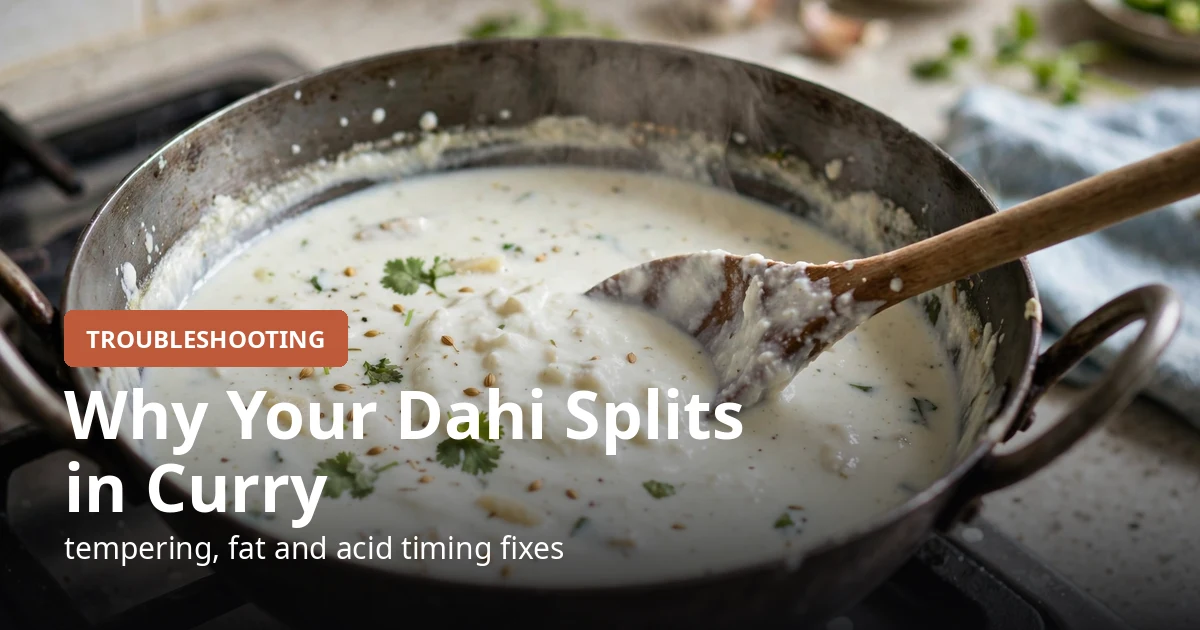

Casein proteins in yogurt tighten and release their whey when the temperature crosses roughly 170 degrees Fahrenheit. That single threshold explains why smooth dahi turns grainy the moment a curry starts boiling hard. The cook stirs in the yogurt, the gravy bubbles, and within a minute the sauce shows white flecks floating in thin liquid. The dish looks broken before it reaches the table. Kadhi, korma, and dahi chicken all depend on yogurt for body and tang, so splitting strikes at the heart of the recipe. This guide explains the tempering method, the fat-content trap, and the acid-timing rule, plus rescue fixes when the split has already happened. Keep reading to keep every curry silky.
The problem
A split curry announces itself instantly. The gravy that should look creamy shows curdled white specks instead, and the sauce thins out as the whey separates. The flavor survides but the appearance fails, and in dishes like kadhi the appearance carries half the appeal. Home cooks feel this failure sharply because yogurt curries demand timing. The spices bloom, the onions brown, and the yogurt goes in at one decisive moment. Get that moment wrong and an hour of work looks ruined. Many cooks stir harder when they see flecks forming, which shreds the curds further. Others add more yogurt to cover the damage, which only adds more protein to split. Some abandon yogurt curries entirely and switch to cream, losing the tang that defines kadhi and korma. The truth is kinder: splitting follows predictable rules, and every rule has a fix you can apply tonight.
Common causes
- Adding cold yogurt to a boiling gravy. The shock of heat makes the casein contract violently and dump whey all at once. Yogurt straight from the fridge hits a 200-degree curry and the protein network tears. Whisk the yogurt smooth, stir in 2 to 3 spoonfuls of the hot gravy first, and only then pour the warmed mixture back into the pot.
- Using low-fat or fat-free dahi. Fat coats the protein strands and cushions them against heat. Low-fat yogurt lacks that protection, so its proteins clump at lower temperatures. Full-fat dahi with 3 to 4 percent fat splits far less readily. For kadhi and korma, always choose full-fat yogurt, and never substitute fat-free versions.
- Letting the curry boil after adding yogurt. A rolling boil pushes the sauce past 200 degrees Fahrenheit, far above the 170-degree danger line. The proteins cannot survive that. After the yogurt goes in, hold the curry at a gentle simmer with only occasional bubbles breaking the surface. Stir steadily for the first 5 minutes until the yogurt fully merges.
- Adding acidic ingredients at the wrong time. Tomatoes, tamarind, and amchur drop the pH, and low pH plus heat splits yogurt twice as fast. Add tomatoes before the yogurt and cook them down fully, so their raw acidity mellows. Add tamarind or amchur only in the last 10 minutes, after the yogurt has stabilized in the sauce.
- Whisking lumpy yogurt straight into the pot. Lumps of yogurt heat unevenly. The outside of a lump overcooks and splits while the inside stays cold. Beat the yogurt with a whisk for a full minute until it pours like heavy cream, and stir in 1 teaspoon of besan or cornstarch per cup for extra insurance in kadhi.
How to fix it
- Set the yogurt out 30 minutes before cooking so it reaches room temperature.
- Whisk the yogurt for a full minute until completely smooth with no lumps.
- Stir 1 teaspoon of besan or cornstarch per cup of yogurt into the whisked dahi for kadhi and korma.
- Lower the curry heat to a gentle simmer before the yogurt goes anywhere near the pot.
- Ladle 3 spoonfuls of hot gravy into the yogurt and stir to warm it gradually.
- Pour the warmed yogurt into the pot in a thin stream while stirring constantly.
- Keep stirring for 5 full minutes until the yogurt melts seamlessly into the sauce.
- Hold the curry at a bare simmer for the rest of the cooking time. Never let it reach a rolling boil.
- Add tamarind, amchur, or extra lemon only in the last 10 minutes of cooking.
- If flecks appear, remove the pot from the heat at once, whisk in 2 tablespoons of cold water, and stir vigorously for 1 minute. This rescue works for mild splits only.
Pro tips
- Hang the yogurt in muslin for 20 minutes for korma. Thicker yogurt brings more solids and fewer splitting surprises.
- Stir with a flat wooden spatula, not a whisk, once the yogurt joins the curry. A whisk tears the fragile emulsion.
- Add a pinch of sugar with the yogurt in kadhi. The sugar rounds the tang and slightly stabilizes the sauce.
- Reheat leftover yogurt curry on low heat and stir often. Microwaving on high splits it again.
- Make kadhi in a heavy pot. Even heat keeps the simmer steady and protects the yogurt.
FAQs
Can I use Greek yogurt in curry?
Yes. Greek yogurt holds more protein and less whey, so it resists splitting well. Thin it with 2 tablespoons of water per cup before adding, since its thickness can make the gravy pasty.
Does salt make yogurt split faster?
No. Salt does not trigger splitting directly. Add salt after the yogurt merges into the sauce anyway, because early salt can draw whey out of the yogurt before it stabilizes.
Can I fix a badly split kadhi?
Yes, partially. Blend the curry smooth with an immersion blender, then simmer it gently for 5 minutes. The texture improves greatly, though a faint graininess may remain.
Should yogurt go in before or after the meat cooks?
No single rule covers every dish. In dahi chicken, coat the raw chicken in yogurt and add it early so the meat cooks in the marinade. In korma, add the yogurt after the onions and spices, when the base turns golden.
Does the type of pot matter for splitting?
Yes. Thin pots create hotspots that push local temperatures past the danger line even on low flame. A heavy-bottomed pot keeps the heat even and protects the yogurt.
Conclusion
Yogurt splits when heat, low fat, or acid overwhelm its proteins. Room-temperature full-fat dahi, tempered with hot gravy, added to a gentle simmer, and protected from early acid stays smooth every time. Keep the boil away from the yogurt and your kadhi, korma, and dahi chicken turn out silky.
Related topics
['TroubleshootingWhy your naan does not puff on the tawa (and how to fix it) ', ' TroubleshootingWhy your samosas break open while frying
 TroubleshootingWhy your seekh kebabs fall off the skewer
TroubleshootingWhy your naan does not puff on the tawa (and how to fix it)TroubleshootingWhy your samosas break open while fryingTroubleshootingWhy your seekh kebabs fall off the skewer
Comments
Comments are saved in your browser only.